
From chronicling African American botanical history to cultivating new community ecosystems in the USA
How Beronda Montgomery connects historical trauma, botanical science, and the urgent need to both affirm and re-imagine our democracy.
Margaret Gray Bayne
Over the last decade, the public has come to recognize that trees communicate through vast underground networks. Neurobiologists have discovered how plants learn, sense, and share memories across time without brains or eyes. Experts and authors including Peter Wohlleben, Suzanne Simard, Richard Powers, and Michael Pollan have explored how these connections allow trees to share resources, signal danger and sustain their ecosystems.
Beronda Montgomery has extended this discourse in a seminal way with When Trees Testify: Science, Wisdom, History, and America’s Black Botanical Legacy (2026). Writing from the perspectives of botanist, historian, memoirist, and traveler in a sweeping survey that moves from the Deep South to points north and west, she provides a more expansive understanding of the historical engagement of African Americans with the botanical world.
Within this context, she investigates seven familiar trees: pecan, sycamore, willow, poplar, mulberry, oak, and apple, alongside the deeply symbolic cotton bush. A central premise is that enslaved Africans were far more than "forced physical labor,” and many were specifically selected for the sophisticated botanical expertise and technical processes they possessed prior to their enslavement." These specialized skills and ancestral knowledge were essential engines of America’s growth.
A former vice president for academic affairs and dean at Grinnell College in Indiana and 2025-2026 Harvard/Radcliffe Fellow, Montgomery is well-equipped to be at the helm of this mapping.
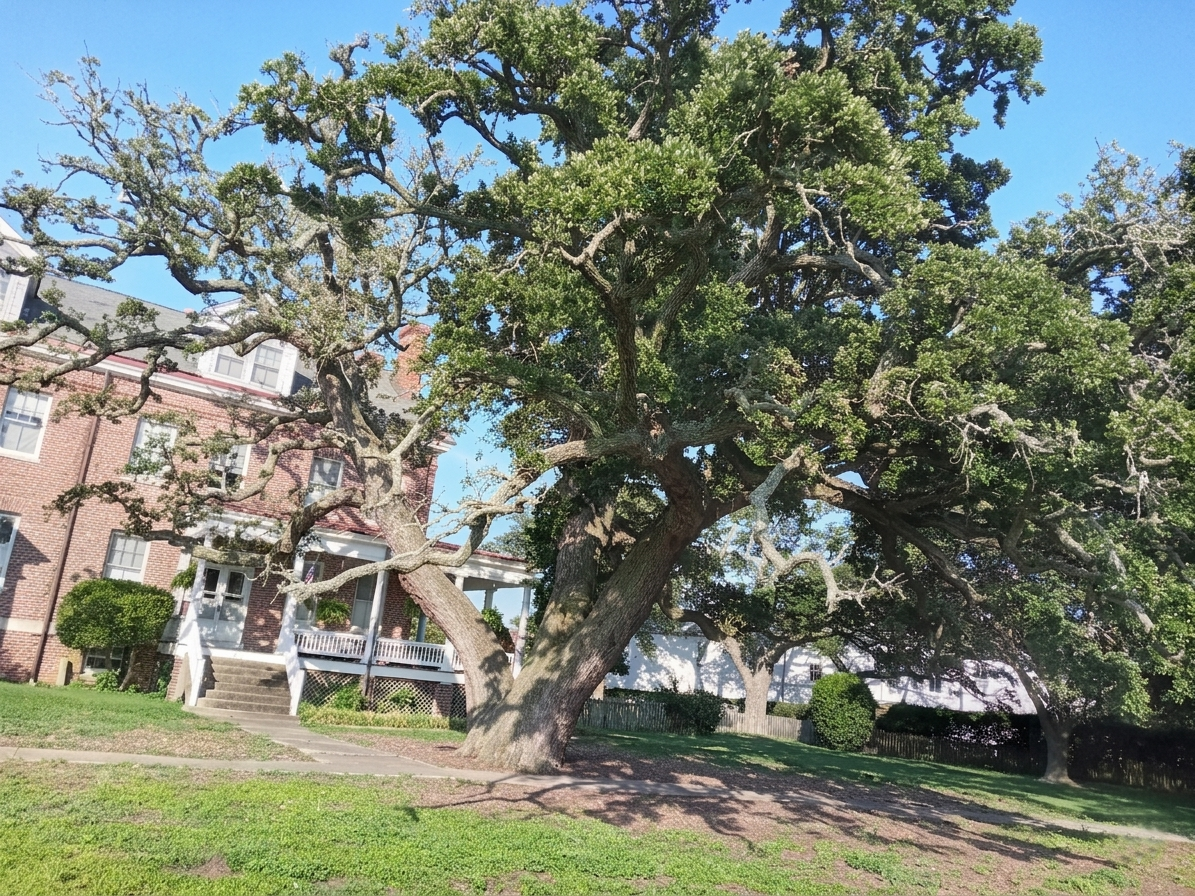
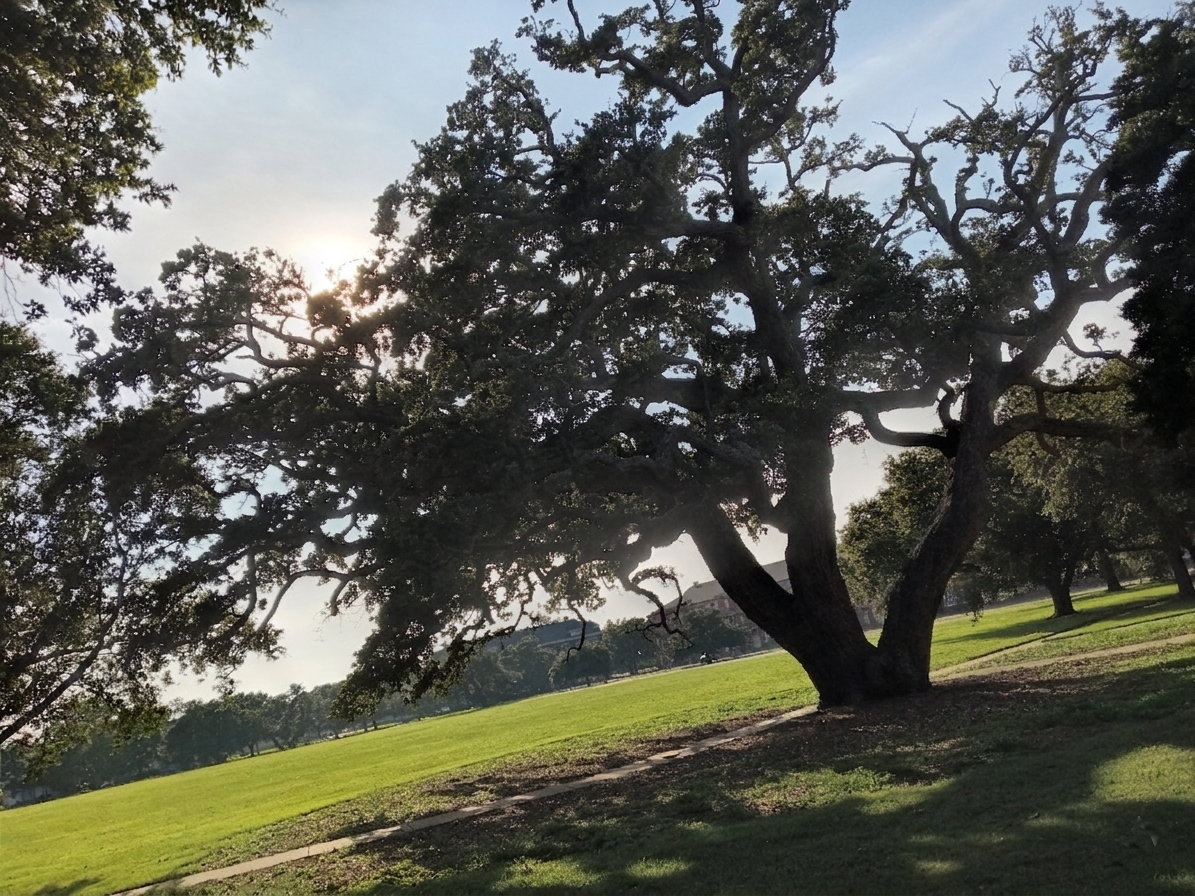
Montgomery believes that trees hold stories and create literal and symbolic connections, as do artifacts and buildings. I am reminded of this concept on walks at the Fort Monroe historic landmark site in Hampton, Virginia. The massive, 500 years old Algernoune hovers like a silent guardian over a large field that once was the military parade grounds. Across from the other side of the field, ringed by buildings, is the site of the hospital where Harriet Tubman attended to black people who sought refuge on and near the fort during the Civil War. “Freedom’s fortress,” they called it.
When I am walking among the massive Algernoune and other ancient oaks, I am reminded that I’m on the grounds that Army nurse Tubman traversed and the trees she passed. Tubman knew trees intimately from her work in the early Eastern Shore Maryland timber industry when she was a young woman. During her daring escapes, she was drawn to trees because she could tell geographical directions from the side on which the moss was growing. (In her later life, she planted fruit trees in her compound in Auburn New York.
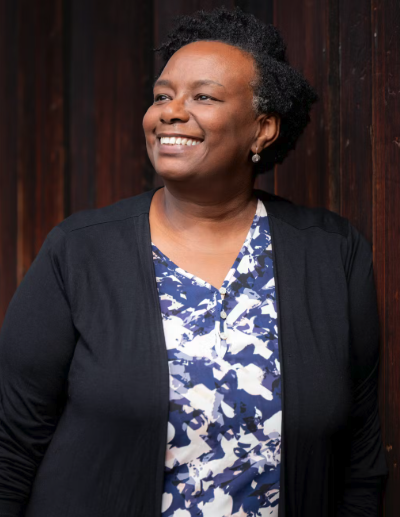
Beronda L. Montgomery, 2025–2026 Sally Starling Seaver Fellow at Harvard-Radcliffe Institute.
Photo: Harvard-Radcliffe Institute.
Left: Algernoune Oak at the Fort Monroe historical site.
The tree was mature before the first Europeans arrived at a nearby shore and shortly thereafter, in 1619, when the first enslaved Africans disembarked at Point Comport which became the Fort Monroe site.
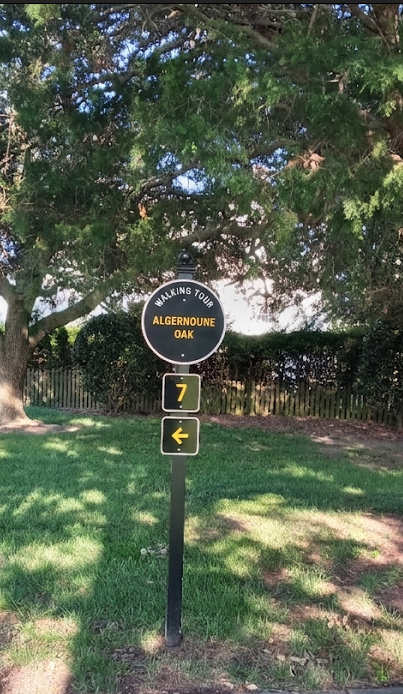
Top right: Sign for Algernoune Oak on a Fort Monroe walking tour that includes signage marking the site where Harriet Tubman served as a nurse during the Civil War.
Algernoune Oak photographs from a group walk sponsored by the Ecollective on August 12, 2023.
Top photo view of Algernoune Oak faces the quadrangle of buildings.
Bottom photo view of Algernoune Oak facing the former military parade grounds.
Barely three miles away from the Algernoune Oak is the Emancipation Oak on Hampton University’s campus. In 1863, black people gathered under the tree to hear the first reading of President Lincoln’s Emancipation Proclamation in the South. The tree also is where Mary Peake, a free born black woman from Norfolk, conducted classes for the newly free black people. During the Civil Rights Movement in 1962-63, students, led by Hampton Institute professor and SNCC co-founder Virginius Thornton, gathered around the tree to sing “We Shall Overcome.”
This landmark tree was threatened with “extinction” in 2016 when the Virginia Department of Transportation proposed an expansion of the I-64 highway that would have included the portion of the Hampton University campus with the Emancipation Oak. The university fought back, and today portions of the Emancipation Oak can be viewed as travelers head towards the highway and the tunnel that connects Norfolk and the city of Hampton.
Early in the When Trees Testify book, Montgomery recounts her discomfort while walking the grounds of the McLeod Plantation near Charleston. It is a visceral uneasiness shared by many black people when visiting plantation and battlefield sites across the country. At George Washington’s Mt. Vernon and Thomas Jefferson’s Monticello, the stark contrasts between the towering big house and the tiny, cramped cabins along the banks of the Potomac or Mulberry Row is impossible to ignore.
For Montgomery such connections to the land can be fraught with generational trauma. Even her mother, an avid gardener, was triggered when saw a cotton plant in a university greenhouse. Mrs. Montgomery remembered her child self being forced to skip school to work in the cotton fields.
These negative botanical associations echo those of my own friends and classmates from Virginia and North Carolina who vowed to leave rural areas and family farms and never work in agriculture again.
So Montgomery advocates a radical act of reclaiming and reframing African American botanical history and memories from an empowered perspectives.
Montgomery’s first chapter, “Pecan Trees and the Roots of Stolen Botanical Knowledge,” perfectly encapsulates this advocacy. She tells the story of Antoine, an enslaved man in Louisiana whose brilliant pecan grafts led to the cultivation of hardier pecans, effectively laying the foundation for a commercial cash crop and the Georgia pecan industry that still thrives today.
Antoine’s story reminds me of a lesson from a college professor years ago, who pointed out that George Washington Carver was an agronomist, someone who cares for crops and soil, not a scientist. The clarification was intended to elevate the work of someone like Dr. Ernest E. Just, a Dartmouth graduate and renowned cell biologist, above Carver.
As young people raised on brightly colored Black History Month posters, we left that class with the biased impression that being in “science” (looking through a microscope in a suit) was inherently better and more intellectual than working the soil.
But science is science, no matter where it is conducted. Our professor likely would have called Antoine a mere “helper.” Montgomery, however, correctly identifies him as a botanist and a pioneer. For her, acknowledging the genius of Antoine and others is essential to healing African American land trauma; it allows us to reclaim our history not just as victims of the land, but as its savvy, stalwart stewards.
This empowered stewardship of the natural environment, however, should also extend to our social systems.
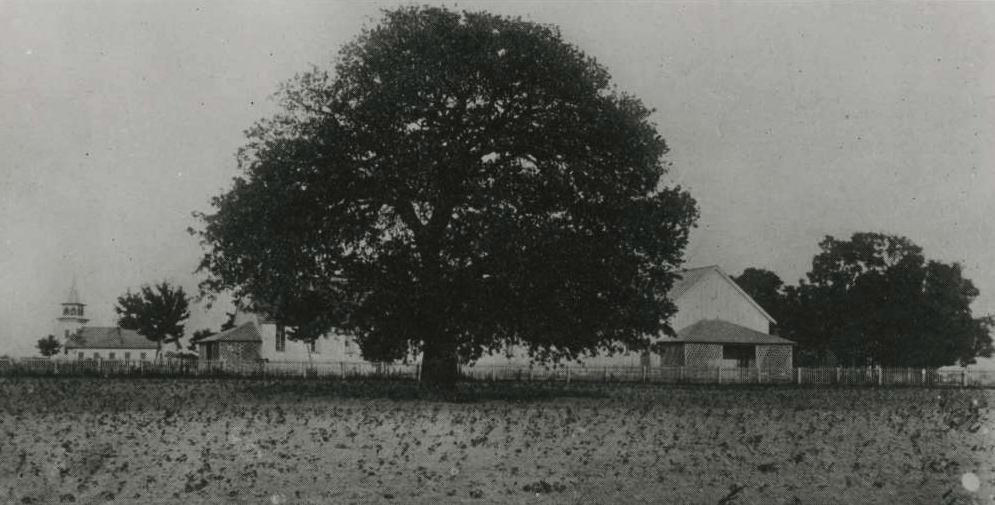
The historic landmark Emancipation Oak with view of agricultural buildings at Hampton Institute, 1907. (Hampton Institute became Hampton University.)
Photo from Hampton Institute, Everyday Life at Hampton Institute (1907). Photo via the Library of Virginia. Rights: CC BY-SA
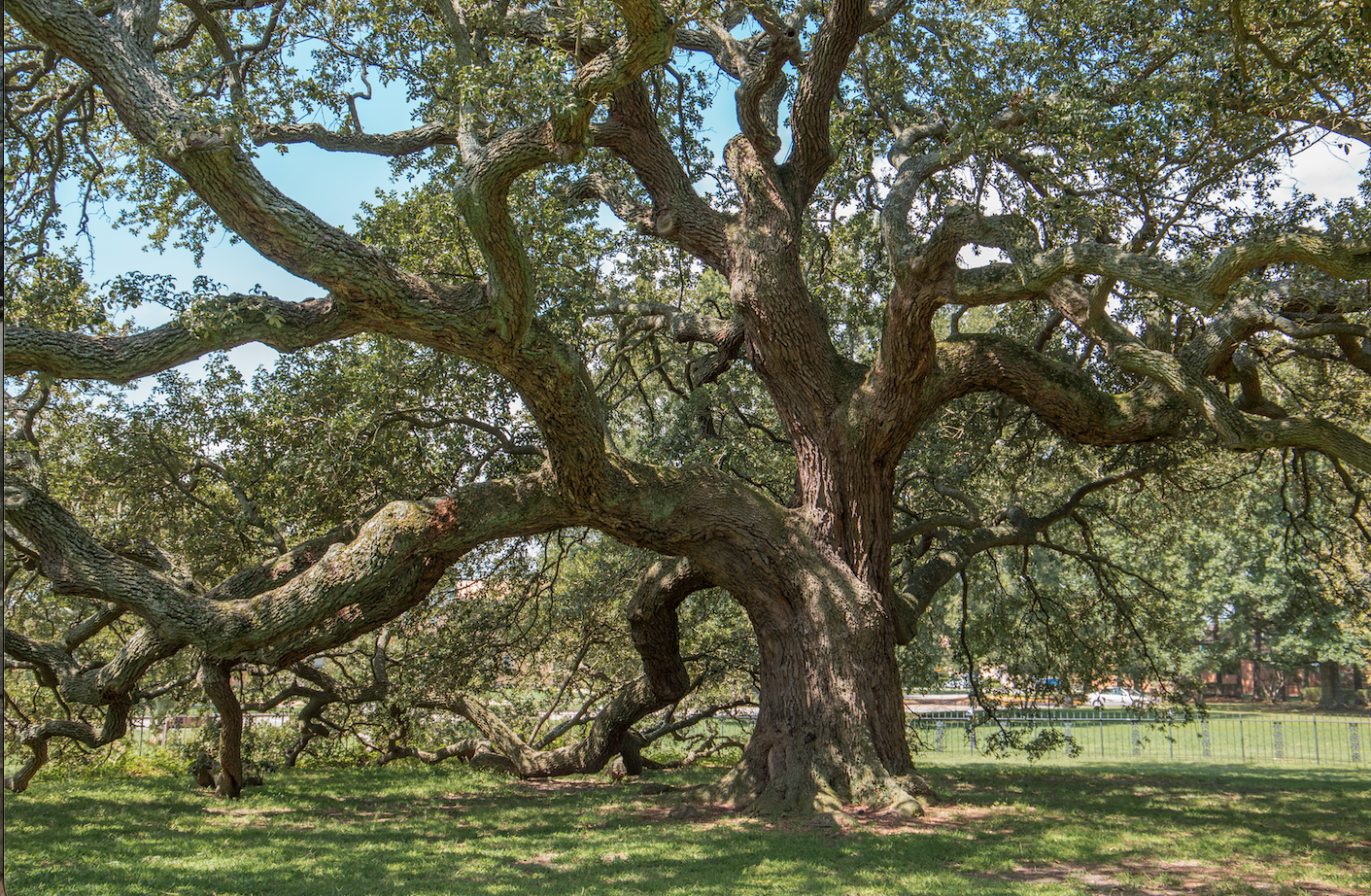
View from beneath the canopy of Emancipation Oak on the Hampton University campus.
Photo by Erik Soderstrom - Own work, CC BY-SA 4.0, Wikimedia Commons.
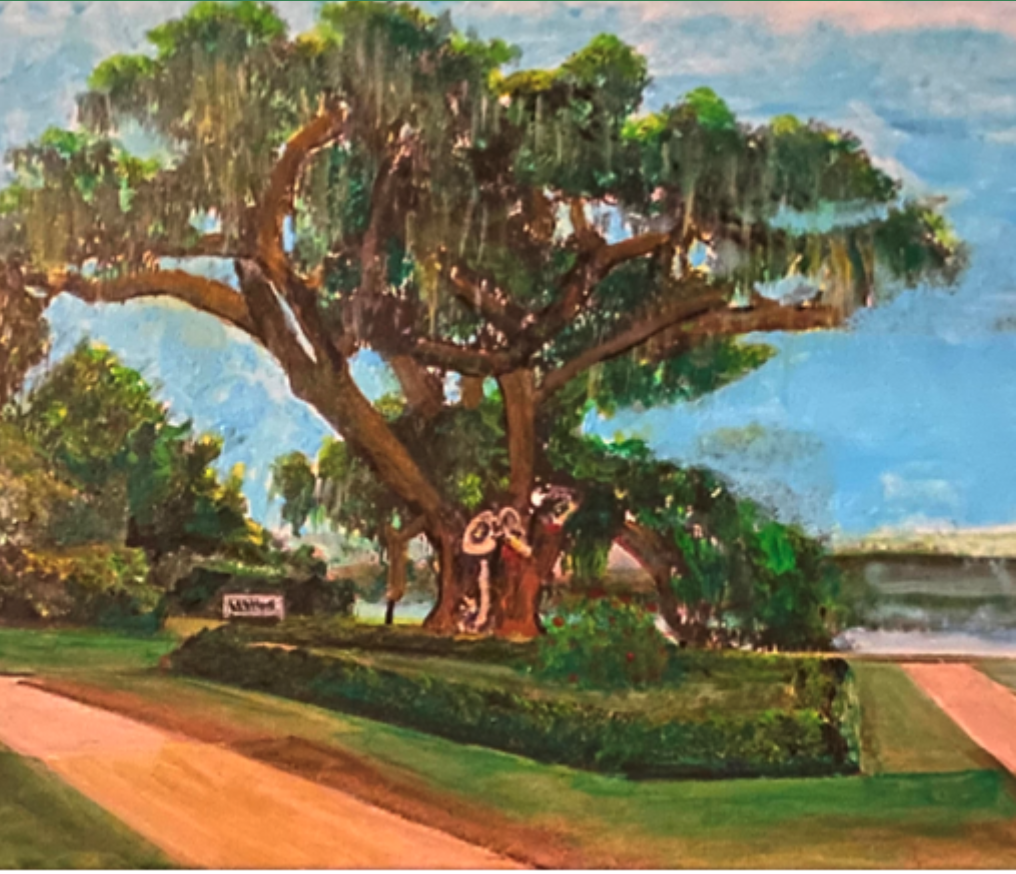
The Middleton Oak or “trading tree” on the grounds of the former Middleton plantation in Charleston, South Carolina.
“Lord Proprietor” Henry Middleton owned land and access to the waterways to the right of the tree that was the site of a bustling rice plantation, lavish estate and African village. Henry Middleton’s son, Arthur ,acquired land and access on the other side of the tree and the seven mile of waterways toward Summerville on the left.
Oil sketch by Ty Collins for the Ecollective article, The Africans who made Carolina gold (rice) worth its weight in gold.
Proposal for how Beronda Montgomery could help chart our nation’s way forward
In preparing this review of When Trees Testify, I watched an interview with Montgomery in connection with the publication of her first book, Lessons from Plants (2021).
One of the “lessons” is that when a houseplant fails to thrive, we immediately ask about the sources of the failure. What’s wrong with its soil or atmospheric environment. Montgomery suggests that plant scientists, who intimately understand how environmental conditions dictate growth, should lead the charge in cultivating communities where all humans are given the conditions they need to flourish.
Today, as we navigate a society being fractured and decimated by the policies of the Trump administration, Montgomery’s philosophy feels like an urgent political and social mandate, as well as a botanical observation. We are living in a climate that is actively stunting the growth and well-being of communities of color and the nation as a whole.
Listening to Montgomery connect her scientific expertise with mentoring roles and community action, and witnessing her natural charisma, empathetic intellect and persuasive speech, it became clear that her vision and capabilities extend far beyond botany. (See video linked below.)
She should have a leadership role among those developing the ideas, principles, and actions needed to reimagine and unify a post-MAGA society.
Beronda Montgomery knows exactly what it takes to cultivate thriving human ecosystems. Right now, that is the kind of knowledge our nation needs to survive and develop its democratic potential.
Margaret Gray Bayne is an Ecollective contributing writer and collaborating editor.
Trees and historical grounds can also have chilling effects
A lesson from plants that is vitally important for human beings
[Interviewer] And what you said in it (the Lessons from Plants book), which I still think about all the time, is that if you have a house plant and it’s sitting on your windowsill and it’s not doing well, you say “What about the environment is causing this plant not to thrive?” Right? So we don’t do that with each other!
[Beronda Montgomery] Yes, yes, yeah, It’s you know, it’s the thing that is most fascinating to me, is that most human beings expect that plants should grow. If you have a plant in your environment, you expect that it should grow, and if it doesn’t you really do go about asking questions about the environment, or your own caretaking skills.
You know I describe my mother as having a green thumb, and so you know that in general impressed me, but (referring to) the point you made: as I look over the years, of all the knowledge we as plant scientists hold, and the fascination we have with the impact of the environment on plants, I thought we should really be leading the charge in terms of building environments of support, you know really focusing on making sure that the environment is in tune for everyone to have the potential to grow; granted we have different potentials, but having the potential to grow.
And so I did start to think that there’s a lot of knowledge in this for the general public, but I think there’s also a lot for us as plant scientists to think about how we can apply all of this wonderful knowledge we have to cultivating our communities with other humans as well.
This excerpt is from the video interview with Beronda Montgomery on the Plantae website of the American Society of Plant Biologists, recorded April 6, 2021 .
“… (with) all the knowledge we as plant scientists hold, and the fascination we have with the impact of the environment on plants, I thought we should really be leading the charge in terms of building environments of support, you know really focusing on making sure that the environment is in tune for everyone to have the potential to grow … .”
— Beronda Montgomery