
What’s going on?
Other recent publications
Abolition and the Rise of US Environmentalism: The Literature and Politics of Free Soil, James S. Finley, August 2026 (UNC Press)
For those interested in the deep historical roots of American eco-criticism, this new book is a must-read. Finley analyzes the 19th-century writings of black abolitionists like Frederick Douglass and Henry Highland Garnet, revealing how their advocacy for truly free soil laid the groundwork for modern environmentalism. By connecting the fight against slavery's destruction of Southern landscapes to contemporary movements for racial and environmental justice, this book redefines the origins of the American environmental movement. See the publisher’s page for more information.
(Children's Eco-Literature) Leave the Trees, Please, Benjamin Obadiah Zephaniah (illustrated by Melissa Castrillón)
Given our appreciation for children's eco-literature like Effie Lee Newsome's Gladiola Garden (see the Ecollective article), this creation by the late Benjamin Zephaniah is a beautiful addition. It follows one family's lifelong, generational relationship with a single tree. And it serves as a gentle but urgent call to protect nature, making it a wonderful resource for young readers learning about ecological stewardship. See the publisher’s page for more information.
State of the Africa Diaspora Report 2026, Ashley Milton and Diallo Sumbry, June 2026
Ashley Milton's report connects policy, governance, data, economic transformation, migration, environmental systems and Africa-diaspora engagement. This highly anticipated transdisciplinary report establishes a baseline for understanding the systems, relationships, and opportunities shaping Africa and its global diaspora. Crucially for Ecollective readers, the report explores how diaspora networks and resources can support climate change initiatives and sustainable industrialization. It is a foundational text for anyone interested in how cultural and historical connections can drive collective environmental action across the Atlantic. View the report: State of the Africa Diaspora Report 2026
Black Climates: Notes on Race, Our Environment, and Visions for Equitable Futures Selina Nwulu, March 2026 (Chatto & Windus)
Poet and essayist Selina Nwulu delivers an essential, empowering exploration of how black people and the climate crisis intersect. Black Climates reframes the global environmental conversation by revealing how the roots of ecological destruction lie deeply entangled in colonialism and exploitation. The book is a powerful call to imagine and build more just, connected, and sustainable futures for communities of color. More about the book here.
Other news
Dr. Robert Bullard at the 2026 International Sustainability Conference
The “dean” of African American environmental justice advocacy, Robert D. Bullard was keynote speaker at the 2026 International Sustainability Conference in Rome, Italy, from October 12 to 15. He advanced actionable solutions to global environmental inequities under the theme "Responding to the Cries of Earth and the Poor."
Los Angeles Environmental Reparations Pilot Program
In September 2026, California advanced a $5 million pilot program designed to provide environmental reparations to black residents in Los Angeles who have been disproportionately impacted by urban oil drilling and toxic industrial pollution.
Africatown Heritage and Infrastructure Protection
The Mobile (Alabama) Environmental Justice Action Coalition's October 2026 agenda highlighted ongoing public participation in the Africatown Revitalization, alongside active community opposition to the expansion of energy-intensive data centers and industrial sites in marginalized Alabama neighborhoods.
New Congressional Environmental Justice Caucus
Earlier this year, grassroots organizations including the Climate Justice Alliance and the Environmental Justice Leadership Forum celebrated the official launch of the new Environmental Justice Caucus in the U.S. House of Representatives, co-led by Representatives Summer Lee and Rashida Tlaib to champion frontline communities.
On the continent
Official Release: An African Call for Climate Reparations, October 14, 2026
Following the historic African Symposium on Climate Reparations held in Mombasa, Kenya, a coalition of over 110 community leaders, scholars, and civil society actors has officially published a unified set of demands. The open letter calls for a consolidated African climate reparations position ahead of COP32 in Addis Ababa, pushing to move reparations from the margins of climate discourse into concrete policy. The coalition fiercely advocates that reparative finance must be provided through direct grants—not debt-inducing loans—and emphasizes that debt justice and international tax sovereignty are non-negotiable pillars of climate equity for the continent. Read the full open letter here: An African Call for Climate Reparations (African Futures Lab)
"Africa Can't Wait" Interfaith Climate Campaign Launched, October 26, 2026
A powerful coalition of faith leaders—including GreenFaith Africa and the Africa Faith Actors Network for Climate Justice—has officially launched the "Africa Can't Wait" campaign. The initiative mobilizes faith networks across the continent to demand urgent, locally-led adaptation and rights-centered ecological restoration based on Indigenous knowledge. As Dr. Pius Oko of GreenFaith Africa stated during the launch: "Our faith calls us to stand together, speak truth to power and build a future in which African communities are not treated as spectators of the climate crisis, but as leaders of the just solutions". Learn more about the campaign here: Africa Can't Wait (ACT Alliance)
Designing Conservation With the Community: A Model in Tanzania, October 29, 2026
As global leaders grapple with the "30 by 30" biodiversity targets (aiming to protect 30% of the planet by 2030), a recent spotlight on Pemba, Tanzania, is proving the power of community-led marine protected areas. Rather than adopting top-down, exclusionary conservation models that displace local populations, Pemba's success illustrates that the only way to achieve meaningful, long-term ecological protection in Africa is to "design conservation with those who will live with it". This approach stands as a vital model for honoring both ecological restoration and Indigenous land rights. Read the full feature here: 'Design conservation with those who will live with it' (Mongabay)
Older posts
The African Symposium on Climate Reparations Convened in Kenya
Hosted by the African Climate Reparations Collective, this landmark two-day symposium was held September 30 – October 1, 2026 in Mombasa. Gathering climate justice advocates, legal scholars, Indigenous leaders, and policymakers from both the continent and the diaspora, the event focused on advancing a unified, Pan-African strategy for climate reparations. A major focus of the symposium addressed the historical foundations of systemic extraction and exploring how to hold the Global North both financially and morally responsible for Africa's climate losses—moving beyond traditional "debt cancellation" to demand true reparative justice. Learn more about the collective's work here: African Symposium on Climate Reparations (African Futures Lab)
UN Launches $78 Million Initiative for the Great Green Wall
On October 6, 2026, the UN Environment Programme (UNEP) announced the launch of a massive $78 million initiative to accelerate land restoration across the Great Green Wall countries in the Sahel region of Africa. This program will restore over 270,000 hectares of degraded land and support the livelihoods of 5 million people—with a specific emphasis on empowering women, who make up more than half of the beneficiaries.The initiative is a powerful step in fighting back against desertification while proving that large-scale environmental restoration must be intrinsically linked to community economic stability and women's leadership. Read the official press release here: New US$78 million initiative to restore land, improve livelihoods (UNEP)
African Methodist Episcopal (AME) Church Launches "Climate Ambassadors" Training
October 2026: The African Methodist Episcopal (AME) Church has officially called all congregants into climate justice action, emphasizing that the burning of fossil fuels disproportionately harms low-income communities, communities of color, and faithful populations across the Caribbean and Africa. To empower local congregations, the AME has launched a free, comprehensive online training program to create "AME Climate Ambassadors." The initiative equips church leaders and community members with the knowledge to speak confidently about climate justice and actively advocate for hyper-local resilience solutions. Explore the AME Church's Environmental Justice Resources: AME Church Climate Justice Initiatives
Obsidian: Soil, Soul, Song Gathering at the Studio Museum in Harlem
On September 26, 2026, the Studio Museum, Harlem, NY presented a day of environmental dialogue, wellness, art, and repair today as Black Girl Environmentalist partnered with the Studio Museum in Harlem for a Climate Week gathering. Rooted in ecology, resilience, and collective well-being, the event featured a central panel titled "Obsidian: The Black Anthropocene." Leaders across the diaspora, including urban farmers, agricultural advocates, and community organizers explored how to center communities most impacted by climate change through ecological stewardship and public policy. The day also included an incredible "soil-punk" demonstration on upcycling invasive kudzu plants into wearable hair beads. Link to event details: Black Girl Environmentalist And Studio Museum In Harlem Climate Week Gathering Obsidian: Soil, Soul, Song
Climate justice activist Vanessa Nakate to Keynote Giving Black Conference 2026
Theme: Rooted & Rising: From The Soil To The Sky
On October 1, 2026 renowned Ugandan environmental activist Vanessa Nakate opened this year's Giving Black Conference, setting the tone for an international gathering linking environmental stewardship to black philanthropy. Her keynote addressed how communities across Africa, the Caribbean, Europe, and North America can reclaim their relationship with the land and water while building the infrastructure to sustain long-term climate action. The conference emphasized that environmental justice and economic justice are deeply intertwined, offering a powerful cultural touchpoint for funders, community builders, and grassroots organizers across the diaspora. Link to conference details: Vanessa Nakate to Keynote Giving Black Conference 2026
Climate Governance & Diaspora Representation
Bonn Climate Talks / Road to COP31
In a major step for global climate justice, a coalition of activists from across the African and Black diaspora are strongly advocating for the formal recognition of Afro-descendant peoples as a specific constituency within the United Nations Framework Convention on Climate Change (UNFCCC). Building on momentum from the recent Bonn Climate Talks, the Global Afro Descendants Movement is demanding meaningful inclusion in global decision-making, emphasizing that local adaptation strategies—from Afro-Colombian traditional nature conservation to mutual aid networks in the U.S. South—are critical to the world's climate survival. Link to advocacy details: Bonn Climate Week 2026 – Indigenous Environmental Network
Kenyan Youth Shatters World Record with 23,326 Trees
Kessup Forest, Elgeyo Marakwet County, Kenya
In an awe-inspiring display of grassroots climate action, 29-year-old Kenyan environmentalist Hillary Kiplagat Kibiwott recently shattered the global record for tree planting. Over a 23-hour period, he single-handedly planted 23,326 indigenous tree seedlings. Operating with the support of his local community, Kibiwott's monumental effort is a visceral reminder that the most effective environmental stewardship is deeply communal. As Kenya works to restore its forest cover, this achievement proves that true power lies not in institutional pledges, but in the hands of dedicated local stewards. Link to full story: How One Young Kenyan's 23,326 Trees Showed the World What Climate Action Looks Like
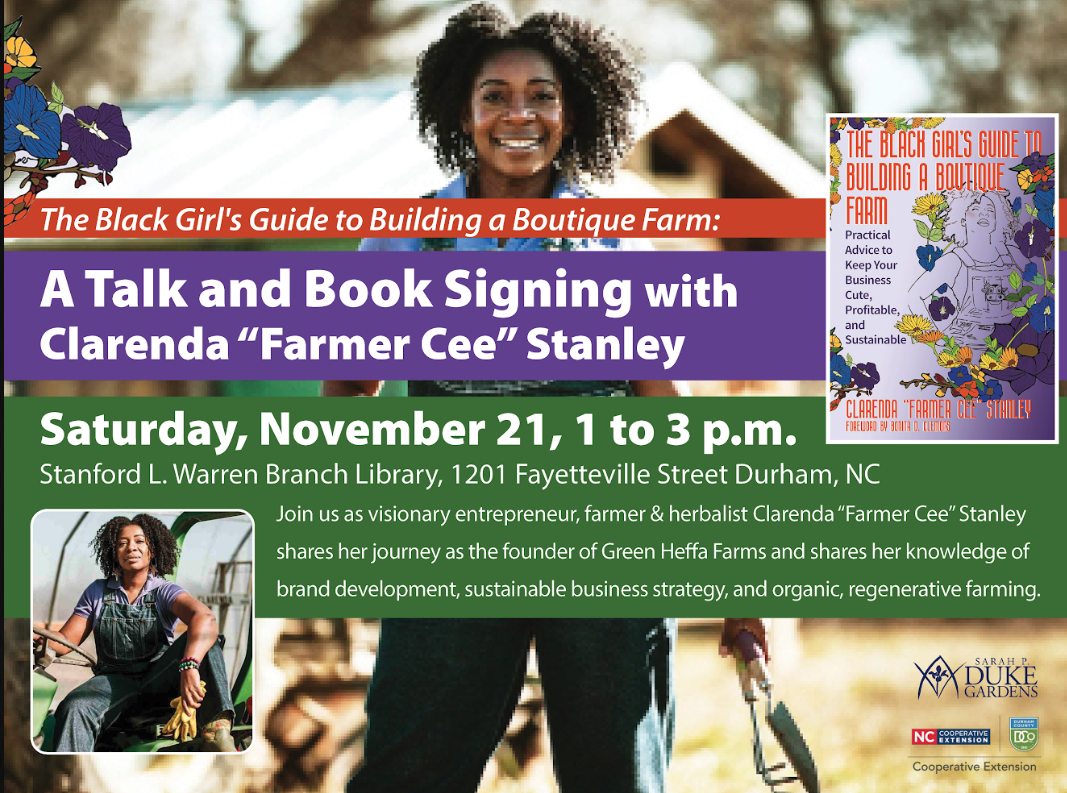
Community gallery
This portal page changes regularly and we invite your contributions to it. For the gallery, we are looking for brief visual exploratory stories. Some of these stories may reveal insights about nature in isolation. We’re also interested in how human actions, spirits, histories, and/or cultures are intertwined with the natural world, as in the story below. You can submit an abstract about a gallery presentation via the message section of our Contact page. If selected, we’ll design a format to fit your content.
This site is designed for desk top monitors and does not display fully on mobile phone screens.

Hattie Meadows designed and cultivated a magnificent garden within a small urban yard
Hattie Meadows’ sophisticated artistic visual imagination was evident when she told a reporter that her favorite view of her garden was through a window “when it’s raining.”
With successive prompts, AI could create a beautiful rendering of Meadows favorite garden view in the impressionistic style of Monet. But that would be contrary to the Ecollective way. We’re developing a more natural way to create honorific, artistic, full color, human-generated renderings of Hattie Meadows’ garden.
On an early spring day in Durham NC in 1953, the “Sun” local newspaper sent a reporter to visit Hattie Meadows, a 68-year-old retired cafeteria manager. The “retired” description refers only to paid employment. Hattie Meadows was still working assiduously in her magnificent garden.
The setting is segregated Durham where every body has “his” or “her” but not “their” place. And the place of a black woman of modest means was at the bottom of the dominant social hierarchy. But Hattie Meadows made the bottom, the foundation, the ground, a heavenly oasis.
The newspaper reporter was also covering a woman in the city’s prestigious white social world. This prominent women’s garden club member had installed a gardeners reading room at the local Sears store which sold gardening supplies. The white gardeners probably had back issues of their subscriptions to House Beautiful and House and Garden magazines, and seed catalogues to share.
Following the news about the reading room was a detailed account of Hattie Meadows’ extraordinarily designed and masterfully executed garden that flourished in a small yard.
Reprint of article from The Durham Sun, April 4, 1953
Year Round Garden
Hattie Meadows, 601 Linwood Ave., has utilized every inch of space in her 60 by 40 foot garden to give variety, succession of bloom and year round enjoyment. Since retiring from the North Carolina Mutual Life Insurance Co. where she worked for 30 years, she has devoted full time to her garden which is in one of the most natural, compact and well planned gardens we've seen in some time. Each border and bed features some favorite and the rock garden in the end of the rectangular area is a climax to the side and center borders.
On the left side of the lot is a 10 foot border with climbing roses in the rear, a lemon tree and redbud tree at the farthest end, nearest the rock garden. Among the dwarf plants for the edging she has used blue phlox, verbena, pansies (some lovely solids which she said were her favorites), violas, sweet william. Included in the wide, well-kept border are some outstanding varieties of roses such as Helen Traubel, Charlotte Armstrong, Peace, Crimson Glory, two New Yorkers, Eclipse, Fashion (she has a total of 60 “good” roses in her entire garden). There are also some watermelon red azaleas, now blooming profusely. Mrs. Meadows prunes her roses and does all of the work in the garden herself.
Center Border
The border which may be termed as being located at the center running left wise features tulips, which are almost ready to open. The rock garden, which has no evidence of cement, but is molded together with huge rocks and moss, has clusters of candytuft, flocks, basket of gold, verbena, oxalis, pinks, thrift. In the lower bed or border, which leads to the fish pond are tulips, jonquils, pansies, feverfew, tall phlox. Over the fish pond is a crepe myrtle tree.
The fish pond, in proportion to the size of the garden, is neither too large or too small. It’s circular shaped and has several varieties of fish in its waters.
Around the pool near the border as abelia, spiraea,. Nearest the house and on the right is a border with daisies, gladiola, thrift, iris, jonquils. In a round center border or bed, there are carnations, phlox, hyacinths, crocus and other annuals. Scattered throughout the garden four tree roses. Over the entrance to the garden gate are pillar roses inline and white shades and to its left after entering the entering the garden are gardenias and foxgloves.
Mrs. Meadows says her favorite view of the garden is through her picture window from her dinette in the rear, “when it’s raining.” The garden in the Linwood Neighborhood is a joy not only to the neighbors but to the school children, hospital employees or passerby. She belongs quite appropriately to the Year Round Garden Club. She and several members of her club and returned by the time of our talking to her, from the Azalea Festival in Wilmington.
“It doesn’t take much time,” Mrs. Meadows said of her gardening. “I’m out in the garden most every day and usually devote one full day a week to it.” We suspect that such a hobby does not need a clock and time to a gardener is the number of days or weeks until the next plant opens its beauty to the world outside. Her garden and its abundance of color and fragrance did not develop in one or two or three years, but over a period of years in which something was added annually, accomplished by diligent care. Right now Mrs. Meadows plans an area in the read similar to a terrace or summer house as the next addition.
—-----------------------------------------------------
Time out of mind in the garden
Some physicists and scientifically-trained philosophers say that the timespace “dimension” is just a navigational framework for what’s giving rise to the physical yet ephemeral appearance of “reality.”
When Mrs. Meadows said her garden did not “take much time” she’s was referring to a realm where time melts with the psyche into the immersive scene.
The Hattie Meadows Gardening School
The Hattie Meadows Gardening School was a free community learning project held at the Stanford L. Warren Library in Durham, January-June 2026, as a collaborative effort between the library, Sarah P. Duke Gardens, the Durham County Cooperative Extension, and the Durham Library Foundation.
The school was named in honor of Hattie Meadows (1885–1966), the dedicated Durham gardener and member of the Year-Round Garden Club which was part of the N.C. Federation of Garden Clubs, a historic black-led consortium.
After managing the cafeteria at North Carolina Mutual Life Insurance Co. for 30 years, Meadows spent time every day cultivating her backyard garden on Linwood Avenue.
The Hattie Meadows Gardening School was organized by Carter Cue, adult services librarian at the Stanford L. Warren branch of the Durham County Library. Carter Cue wrote about North Carolina Negro women’s clubs in the “Sowing the seeds of black horticultural history” article in the Ecollective.
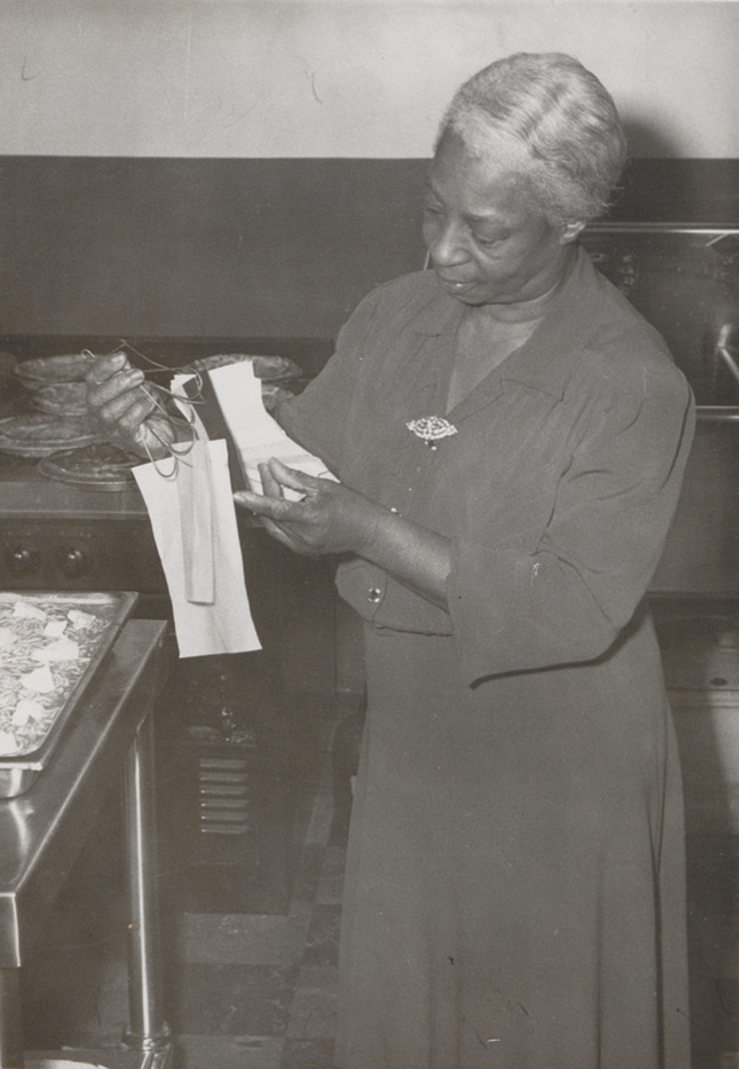
Hattie Meadows was the NC Mutual Life Insurance Company cafeteria manager. She’s shown here putting napkins into a holder.
Meadows was a member of the Year Round Garden Club (Durham), an affiliate of the NC Federation of Garden Clubs, formerly the NC Federation of Negro Garden Clubs formed in 1935 on the campus of NC A&T State University.
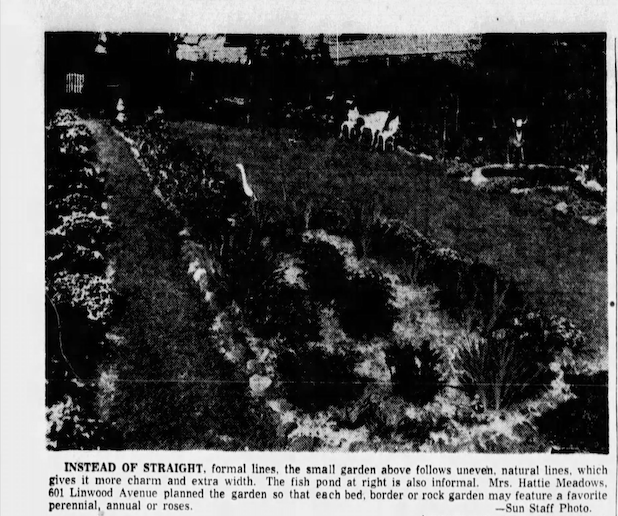
Above: poor quality 1953 newsprint photo of Harriet Meadows’ garden in the 1953 Durham Sun newspaper.
Here is a breakdown of the key elements visible in this indistinct photo, sticking to what is observable in the image:
1. Central Garden Bed & Path
Curved bed: A wide, curved flower bed runs diagonally through the middle of the frame, lined with various low-growing plants, foliage, and perennials/annuals.
Rock bordering: Rocks and stones border the edges of the bed, creating an irregular, natural line rather than a straight border.
Tall white ornament: Standing near the middle of this central bed is a tall, slender white garden figure (appearing to be a decorative bird statue, such as an egret or heron).
Left pathway: A clear grass or dirt walkway runs along the left side of the central bed, bordered by another strip of dense plantings along the far left edge.
2. Fish Pond (Upper Right)
Pond area: In the upper right section of the yard, there is a small, oval-shaped fish pond surrounded by informal rock edging.
Pond statue: A tall, slender ornamental statue (appearing to be a standing bird or small figure) is positioned right at the edge of the pond.
3. Lawn & Background Features
Lawn Statues: On the open grass in the upper-middle background, there are two distinct white animal statues standing together (resembling small deer, horses, or lawn figures).
Fencing: In the far top-left corner, a small white wooden gate or fence panel is visible near the back boundary line.
Trees/Shrubbery: Dark foliage and trees line the outer edges and top background, enclosing the backyard space.

Contemporary view of Hattie Meadow’s former residence at 601 Linwood Avenue, Durham, NC. Source: Apple Maps.
Hattie Meadows Gardening School Videos
Seed Starting - Hattie Meadows Gardening School Presented by Marcia Kirinus, Extension Master Gardener volunteer, Durham County
Design Thinking, Part 1 Presented by Stefan Bloodworth, Owner and Principal Designer at S3 design and former curator of the Blomquist Garden of Native Plants at Sarah P. Duke Gardens
Design Thinking, Part 2 Presented by Stefan Bloodworth, Owner and Principal Designer at S3 design and former curator of the Blomquist Garden of Native Plants at Sarah P. Duke Gardens
Garden Design with Native Plants Presented by Sheldon Galloway, Owner and Head of Operations at Garden Environments
Water Features Presented by Sheldon Galloway, Owner and Head of Operations at Garden Environments
Containers With a PurposePresented by Teresa Speight, Author of Black Flora: Inspiring Profiles of Floriculture’s New Vanguard and owner of Cottage in the Court
The Dirt on SoilPresented by Ashley Troth, PhD, Horticulture Agent, Durham County Cooperative Extension
Tomatoes to Turnips: Tips for Planning Your Year Round Garden Presented by Molly Zimmerman, Extension Master Gardener volunteer, Durham County
Growing Better Veggies Presented by Ashley Troth, PhD, Horticulture Agent, Durham County Cooperative Extension
Hearty Landscapes: Foodscaping for Joy, Beauty & Abundance Presented by Brittany Robinson-Wittenhill, Founder of Our Backyard, LLC
Native Fiber and Dye PlantsPresented by Adé Oni, founder of dìèdìè textile micromill and studio
History of Gardening Presented by Bryce Lane, NC State Alumni Distinguished Undergraduate Professor Emeritus and former host and producer three-time, Emmy winning, UNC TV public television show “In the Garden With Bryce Lane.”
Essential Pruning Techniques Presented by Mike Gibson, Topiary Artist and founder of Gibson Works Property Art
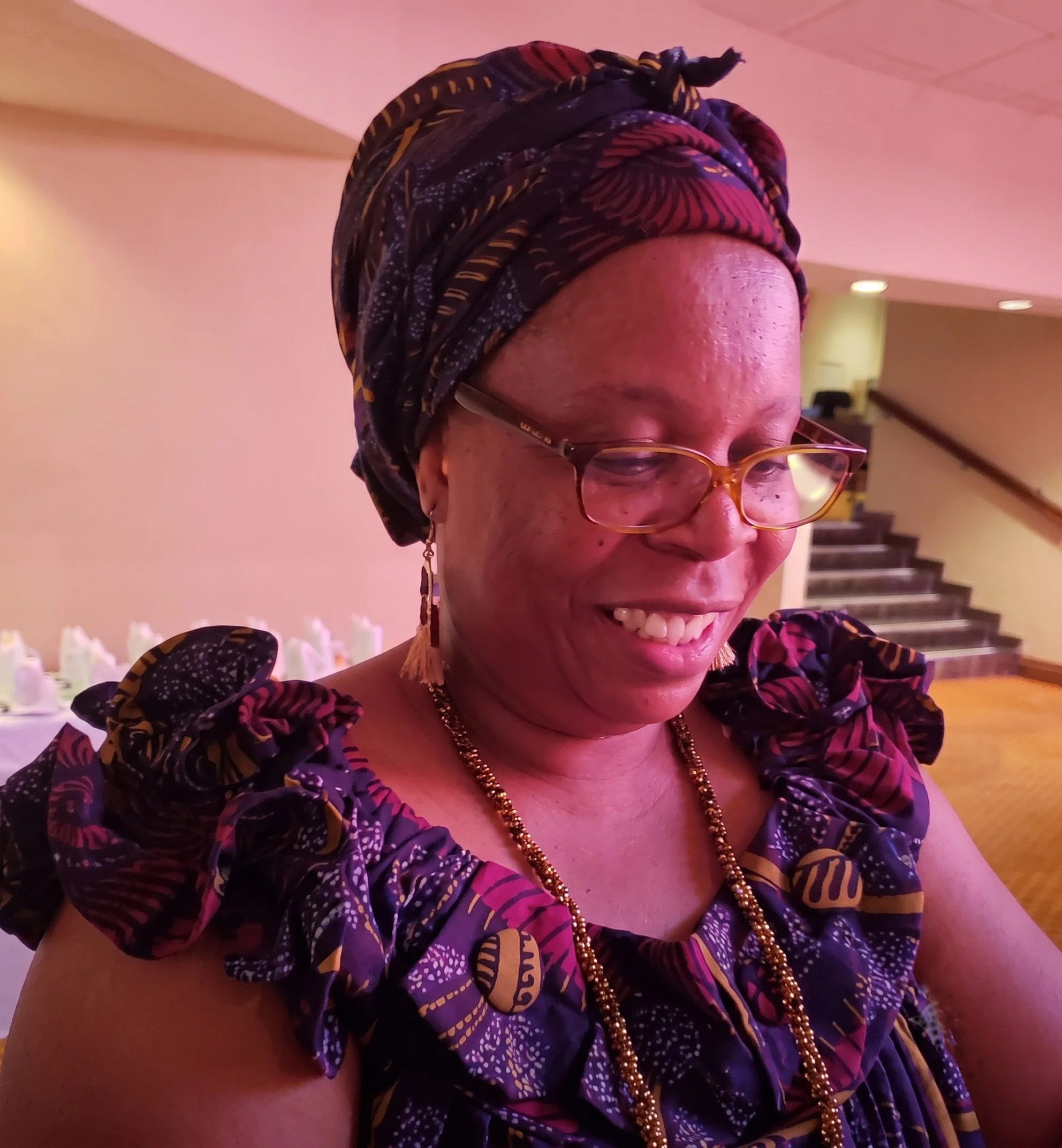
African Ecofeminists Convene to Challenge Extractivism in the Clean Energy Transition Harare, Zimbabwe — July 8, 2026
As the global demand for transition minerals like lithium, cobalt, and copper skyrockets, African ecofeminists convened in Harare this July to ensure the continent is not subjected to another era of resource exploitation under the guise of climate action. Hosted by SHINE Collab under the theme "Building Ecofeminist Futures Beyond Extractivism," the gathering featured activists from across the continent, including the DRC, Malawi, and South Africa.
The coalition called for a just, people-centered energy transition that protects frontline communities and biodiversity. Participants stressed that renewable energy investments must uphold human rights, respect traditional knowledge systems, and recognize women's leadership as central to building resilient, equitable societies.
Read more about the convening here: African ecofeminists call for a just energy transition (EnviroNews)

Mela Chiponda,
director, SHINE Collab
Dorceta Taylor
Dorceta Taylor Unveils the World's First Environmental Justice Encyclopedia
July 2026
Pioneering environmental sociologist Dr. Dorceta Taylor continues her lifelong work of expanding representation in the climate sector. Profiled extensively this month, she is actively challenging the historical narrative that environmentalism "wasn't a Black thing". Her monumental ongoing work on the world's first environmental justice encyclopedia highlights the crucial, yet often erased, contributions of Black Americans and people of color to the conservation movement.
Read the full profile here:
Meet the woman behind the world's first environmental justice encyclopedia (The 19th News)
Federal Judge Restores $127 Million for Black Farmers and Agricultural Grants
July 19, 2026
In a major victory for food justice and agroecology, a federal judge recently ordered the reinstatement of $127 million in USDA grants directed to organizations supporting Black farmers and other farmers of color. These Increasing Land, Capital, and Market Access Program funds are critical for agricultural cooperatives to purchase land, acquire equipment, and sustain local community food programs. This ruling allows essential, long-term equity projects in the agricultural sector to resume after their funding was previously targeted and canceled.
Read the full story here:
Black Farmers Federal Grants Restored (San Antonio Observer)
Black Girl Environmentalist Steps Up for the Potomac River
July 1, 2026
The DMV (DC, Maryland, Virginia) hub of the national nonprofit Black Girl Environmentalist (BGE) is making waves locally by partnering with the Potomac Conservancy. This summer, they are leading critical waterway conservation efforts and litter cleanups along the Potomac River. BGE's ongoing initiatives are creating powerful spaces for Black women to connect with the earth while actively fighting the "green ceiling"—working to boost retention and representation for Black women across the climate sector.
Read the full story here:
Rooted in Community and the Potomac Region (Potomac Conservancy)
117th NAACP National Convention Wraps Up with a Focus on Environmental Justice
July 24, 2026
Thousands of civil rights advocates and youth leaders gathered in Chicago for the 117th NAACP National Convention under the theme "We, The People." Closing late this July, the convention’s mainstage discussions and policy planning sessions placed a massive emphasis on environmental justice alongside voting rights and economic equity. The mobilization continues to align with the NAACP's "Black Climate Week" campaigns, fiercely defending communities against the disproportionate placement of industrial sites and energy-intensive AI data centers in Black neighborhoods.
Read the full recap here:
117th NAACP National Convention Ends in Chicago (NAACP News)

Eco Revolution: Climate Justice, Community, and the Fight for Our Planet
Maya Penn, June 2026
Maya Penn was eight years old when she became an activist. The award-winning environmental artist and animator is now 25 years old and bringing more than a decade of hands-on advocacy to her newest release. Featured prominently in June's eco-literary roundups, Eco Revolution addresses the climate crisis while highlighting the deep-rooted overlap between social justice and environmental action. It offers an inspiring, highly accessible blueprint for community-led change and youth leadership in the climate movement.
Link to Feature: June 2026 Environmental Books (The Revelator)
Proceedings on "Migrations and Climate in Africa"
How are environmental crises shaping the future of the African Diaspora? On June 15, 2026, the International Migration Research Network (IMISCOE) published the highly anticipated proceedings and recommendations from their landmark conference, "Migrations and Climate in Africa: Emerging Dynamics and Future Challenges."
These newly released documents show how climate pressures are driving internal, cross-border, and transcontinental displacement. The research highlights the local African actors, focusing on community adaptation strategies, the role of women and youth in climate mobility, and how traditional agricultural and pastoralist communities are navigating rapid environmental changes.
View the findings and proceedings here:International Conference: Migrations and Climate in Africa - IMISCOE
Urban Forests and Green Spaces in Africa
Urban green spaces are not just a luxury, they are a vital response to climate change, biodiversity loss, and community health. Just published by the Johannesburg City Parks and Zoo, Urban Forests and Green Spaces in Africa: Case Studies and Lessons from Across the Continent is a pioneering new book featuring 34 case studies from 14 African countries.
Authored predominantly by African researchers and practitioners, the 170-page, highly illustrated book highlights innovative greening approaches from transplanting giant baobabs in Senegal and creating Miyawaki forests in Kenya, to restoring biodiversity around wetlands in Rwanda. It is essential reading for anyone interested in how traditional knowledge and local action can help our cities adapt and thrive.
Read more about the book here:
As African cities heat up, a new book argues trees are part of the solution (Mongabay)

Soul Fire Farm event
Children of the Land: Soul Fire Farm’s Approach to Raising and Mentoring Young People
Live Online Course with Leah Penniman
DEC. 1 - 22, 2026
TUESDAYS 12 - 1:30 PM (PT)
In this live course, Leah Penniman invites participants into the teachings and stories of Soul Fire Farm, where young people are raised through shared responsibility, earth-based learning, and intergenerational cooperation. Grounded in Afro-Indigenous wisdom, the course offers caregivers and educators practical insights for nurturing children who are rooted, connected, and supported in discovering their unique paths. The course is sponsored by Bioneers. Register here.

Jacqui Patterson (Photo: The Chisholm Legacy Project)
International Climate Finance & Leadership
The Chisholm Legacy Project at the June 2026 Bonn Climate Talks
At the UN Climate Change Conference in Bonn, Germany, Jacqui Patterson, founder and director of The Chisholm Legacy Project, delivered a powerful vision for climate finance. Speaking on the panel "How Can the Just Transition Mechanism Support Holistic Transition across Sectors?" Patterson outlined what “just transition climate finance looks like through a black liberation and feminist lens.”
Patterson advocated for a major shift in climate philanthropy: moving funds away from "Big Green" organizations and directing them straight to the frontline and grassroots groups performing daily environmental work in communities.
Historic Anacostia community environmental resourcefulness
In her new book, Tiny Gardens Everywhere: The Past, Present, and Future of the Self-Provisioning City, historian Kate Brown provide a history of urban food production. A striking example in the book is the Anacostia communuty in Washington, D.C. During the 1910s and 20s, black residents there faced systemic neglect from city planners who refused to provide basic infrastructure like sewers or garbage pickup. In response, these residents developed an impressively resourceful closed-loop ecosystem. They managed waste through innovative composting systems and pig farming, and engineered their own water filtration systems using roof runoff and gravel—effectively inventing sustainable urban living. As Brown notes, they “were doing all the things that would be considered green architecture today.”
Archived items
Black Atlantic Worlds: Landscape Histories of the African Diaspora
Edited by Oscar de la Torre
Published May 2026 (Harvard University Press)
This groundbreaking collection explores how Africans and their descendants have populated, stewarded, and transformed ecosystems across the Atlantic rim. Moving from West African land and water practices to Afro-diasporic geographies, the book dives deep into the connections between environment, identity, and resistance. It is an essential read for anyone exploring the historical memory embedded in our landscapes and the legacy of black ecological knowledge.
Have an announcement? Send details in the message section of our Contact page for the announcement to be reviewed for posting at the top of this page.
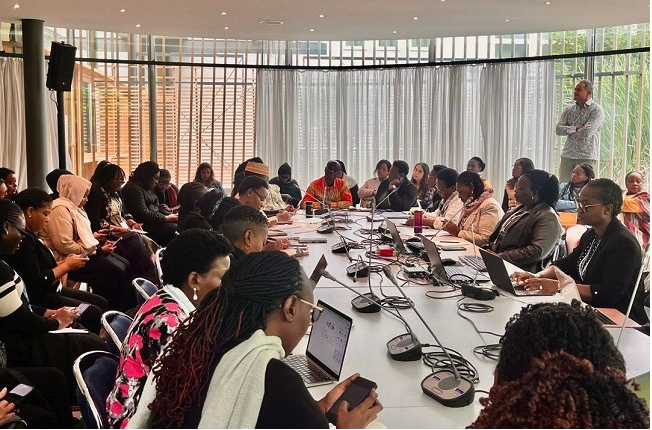
Photo: UN climate negotiations in Bonn, Germany
June 15, 2026: African Group of Negotiators on Climate Change (AGN) called for a stronger, more coordinated African women’s agenda within global climate governance.

New series for Rae Wynn-Grant
Wildlife ecologist Rae Wynn-Grant and National Geographic Explorer Bertie Gregory are the leads in the Nat Geo series, Secrets of the Bears. Premiering in spring 2027, the series will explore charismatic brown bears and secretive sun bears, and reveal new science and never-before-seen behaviors that show bears are smarter, more adaptable, and even more sociable than people ever imagined.
Dr. Rae Wynn-Grant is shown here in a detail from the cover of her Going Wild memoir. For more about the memoir and Wynn-Grant’s life beyond the book, see the Ecollective article, Tears and fears and feeling proud.
Opportunities for nature-inspired and environmental justice writing
Panorama journal’s "Reflections" theme seeks essays, poetry, and "new nature writing" from historically marginalized communities to discuss environmental and climate justice. For more info: panoramajournal.org/submissions/calls
Flyway: Journal of Writing & Environment publishes poetry, fiction, nonfiction, short scripts, and visual art that explores the many complicated facets of the word environment and encourages submissions from from diverse voices and under-represented populations, including — but not limited to — international authors, people of color, members of the LGBTQ+ community, those with disabilities, and the elderly. For more info: https://flywayjournal.org/about/
The Dodge seeks fiction, creative nonfiction, poetry, visual art, and translation focused on the environment. We’re excited by a wide range of forms and approaches, including hybrid and experimental work. We especially seek creative works that imagine a just future for the planet. Given our focus on environmental justice, we’re eager to champion emerging and marginalized voices underrepresented in magazine publishing and eco-writing, including writers and artists who are Black, Indigenous, people of color, people who are trans, gender-nonconforming, and LGBTQIA+, people with disabilities, women, and others. For more info: https://thedodge.submittable.com/submit
Ecotheo publishes poetry, prose and visual art exploresquestions of ecology and spirituality. For more info: https://www.ecotheo.org/submit
Terrain.org welcomes submissions in English (or translation) from around the world, and particularly Indigenous, Native, Black, Brown, and other historically marginalized and underrepresented voices. They pay $50 for all contributions. For more info: https://www.terrain.org/submit/