
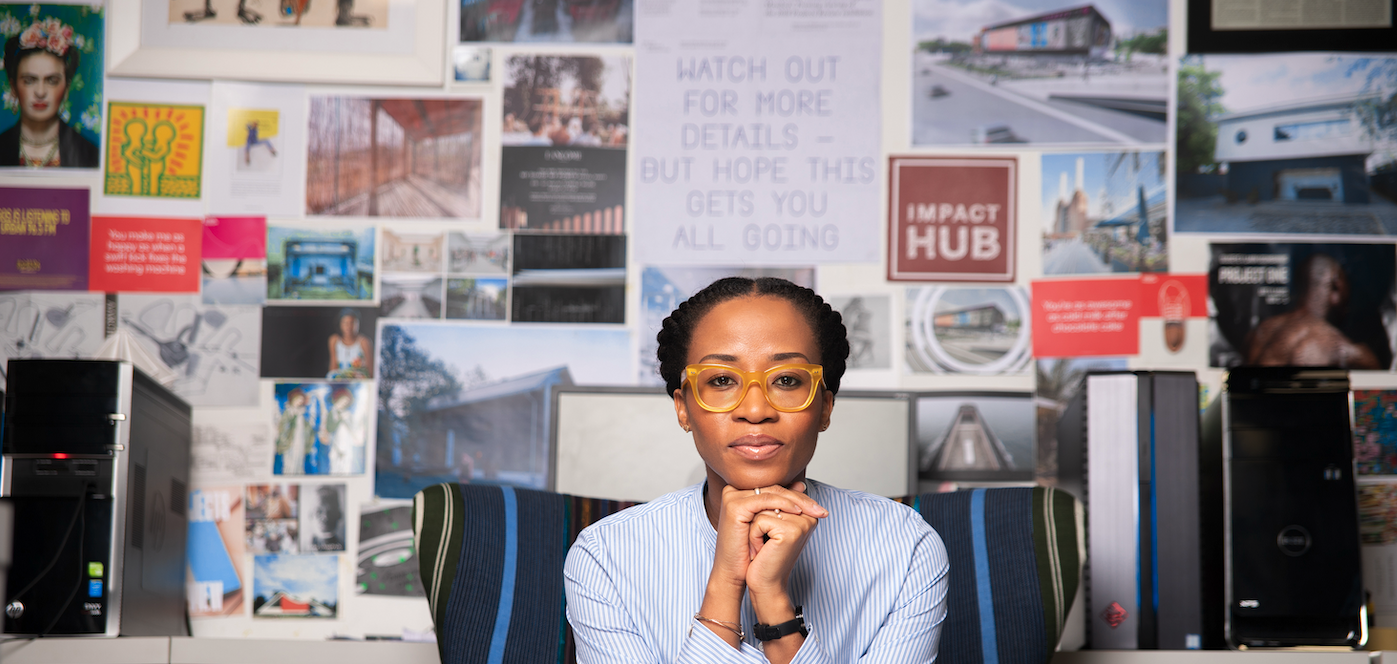
Tosin Oshinowo
Photo: Source Creative
How Africa Can Lead into the mid-21st Century
Architect Tosin Oshinowo and Lagos, the city of the future
Zack Littlejohn
Lagos is a city of impressive scale. The second most populous in Africa, it is home to over 20 million with one of the youngest and fastest growing populations on the continent. It boasts one of the biggest metro economies on the continent and is the engine of one of the continent's biggest national economies. The bustling metropolis on the sea is the economic and political heartbeat of West Africa and in the coming decades will become one of the largest and most important cities on the planet.
Lagos is the city of the future. However, we do not recognize it as such. Lacking the large capital investment, extensive infrastructure, modern technology, centralized planning, and other amenities that global powerhouses like New York, London, or Tokyo boast, it is seen as a ‘developing’ city having not yet arrived at modernity. These other metropolitan powerhouses fit into a conventional Western notion of development, progress and modernity. It is a fixed concept which societies around the world seek to emulate.
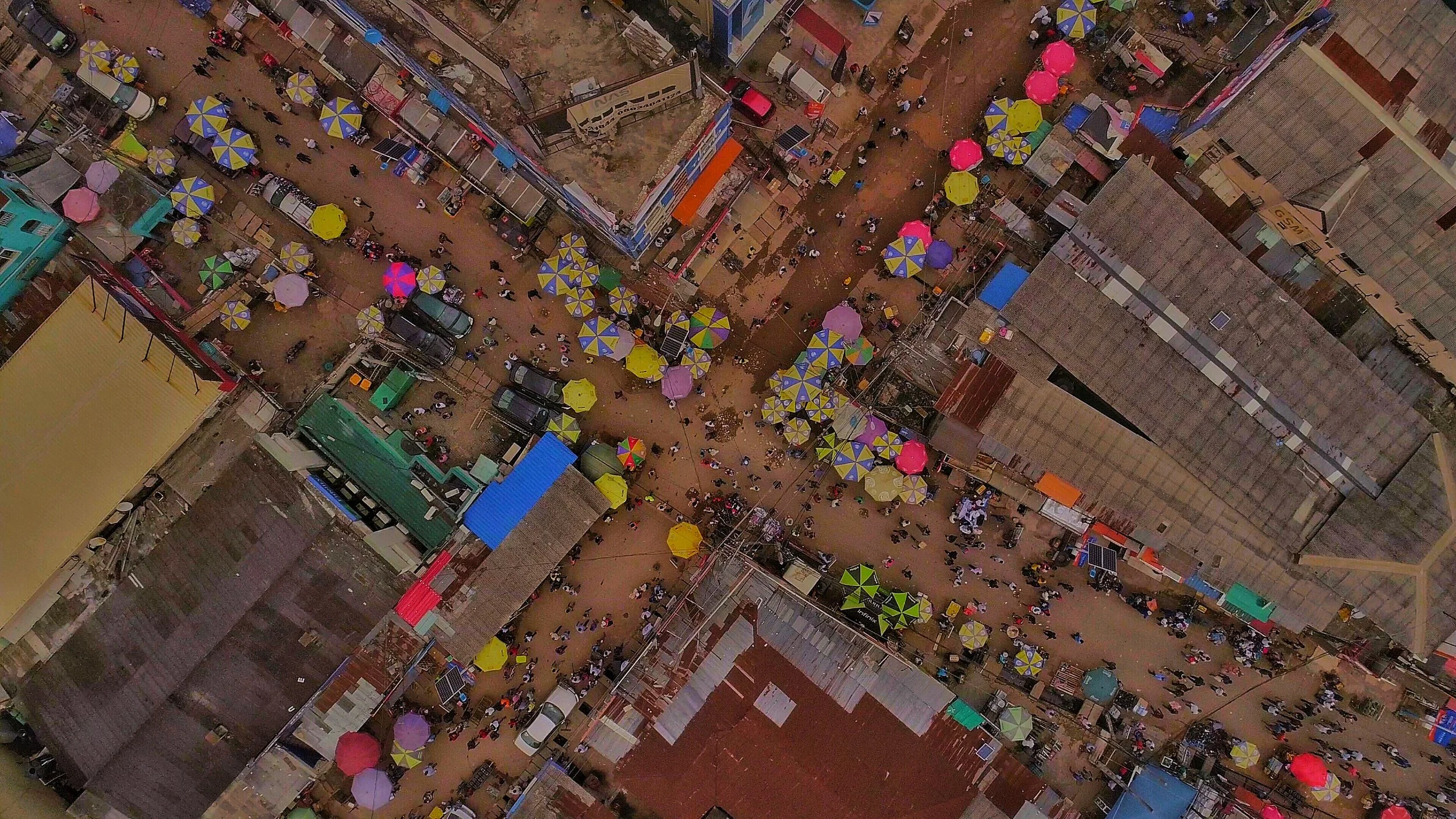
Aerial view of the Computer City conglomerate of markets in Lagos, Nigeria, November 2017.
Source: Tosin Toromade - CC BY-SA 4.0, https://commons.wikimedia.org/
What do visionary approaches to designing the built environment and developing economies without large-scale industrialization look like?
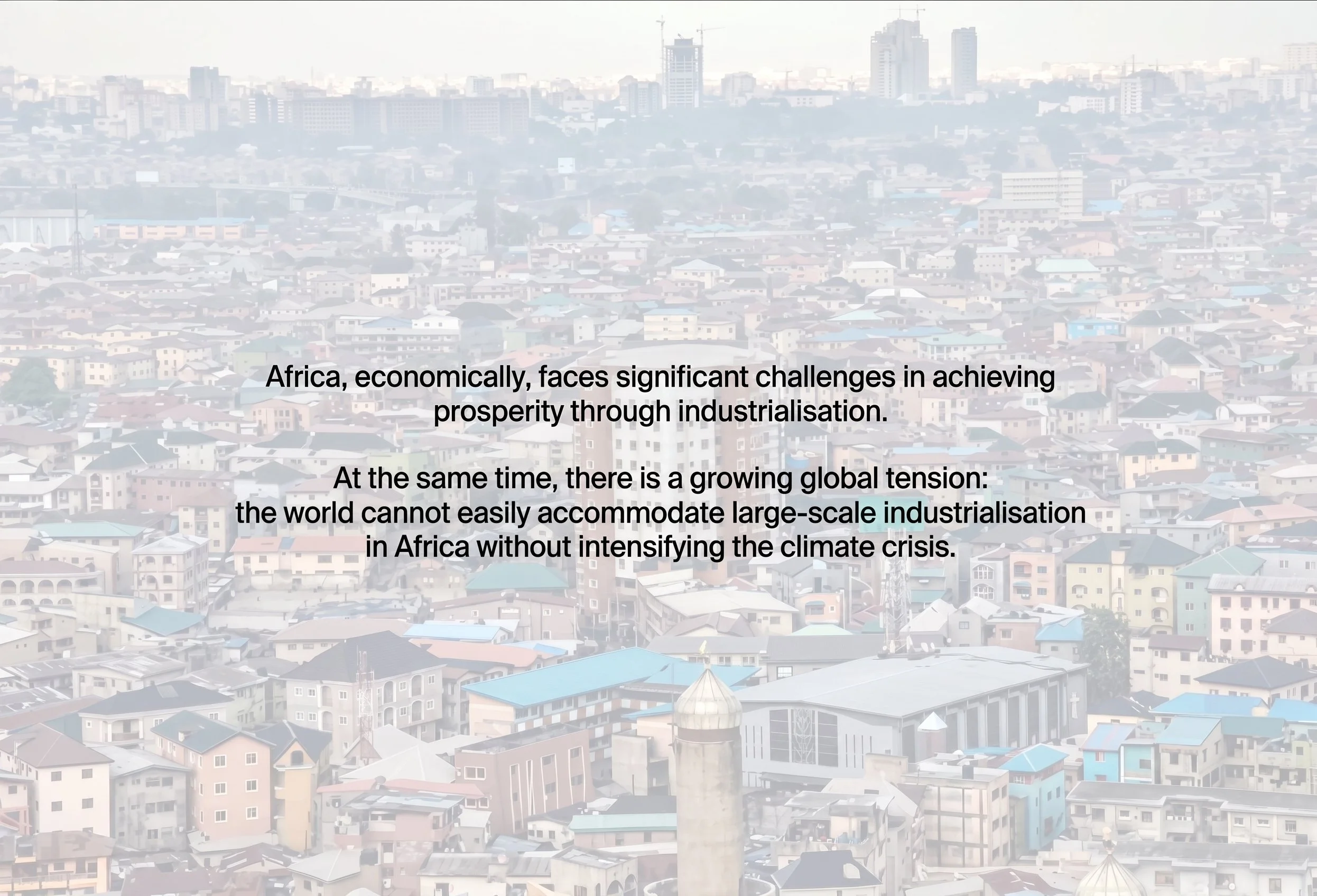
Slide with text superimposed over photo of Lagos business district from Tosin Oshinowu’s talk at the Technical University of Delft, the Netherlands in April 2026.
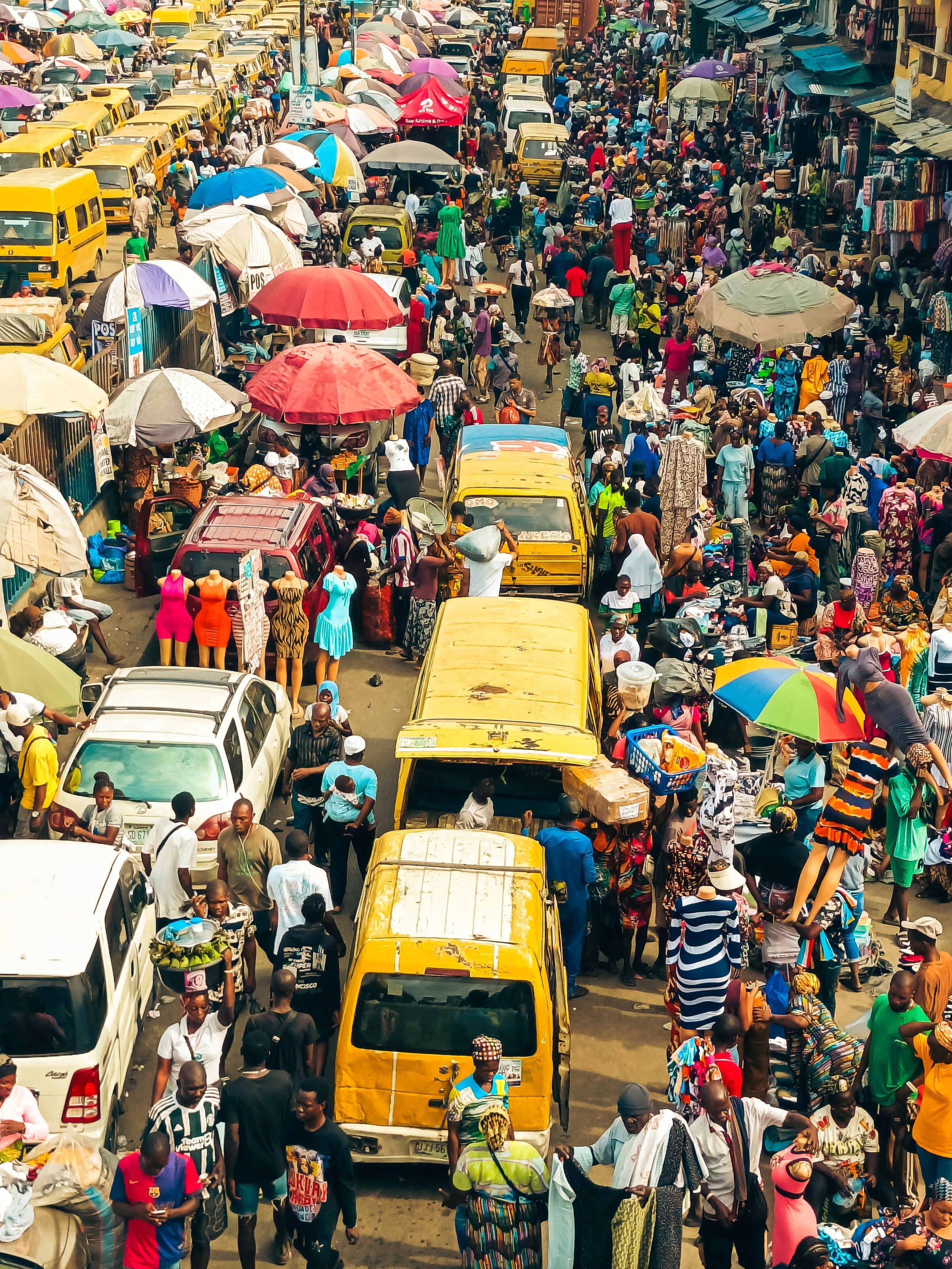
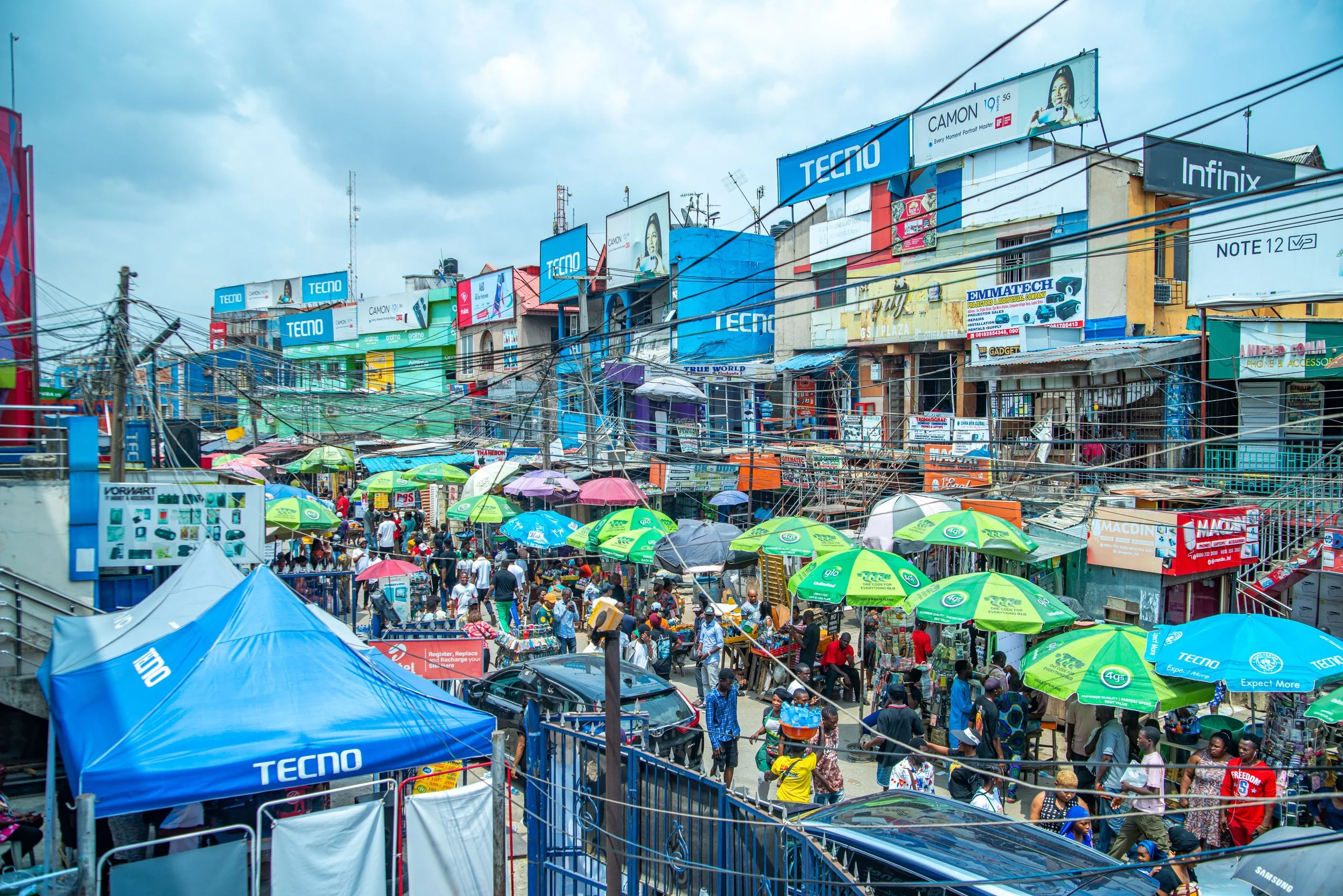
Tosin Oshinowo views self-organizing elements of the Lagos street markets in ways that can be adapted for bottom up, environmentally-sound, city planning and development.
Photos: (l-r) Fawaz Onakoya, David Iloba, Murisiku Amure via Pexels
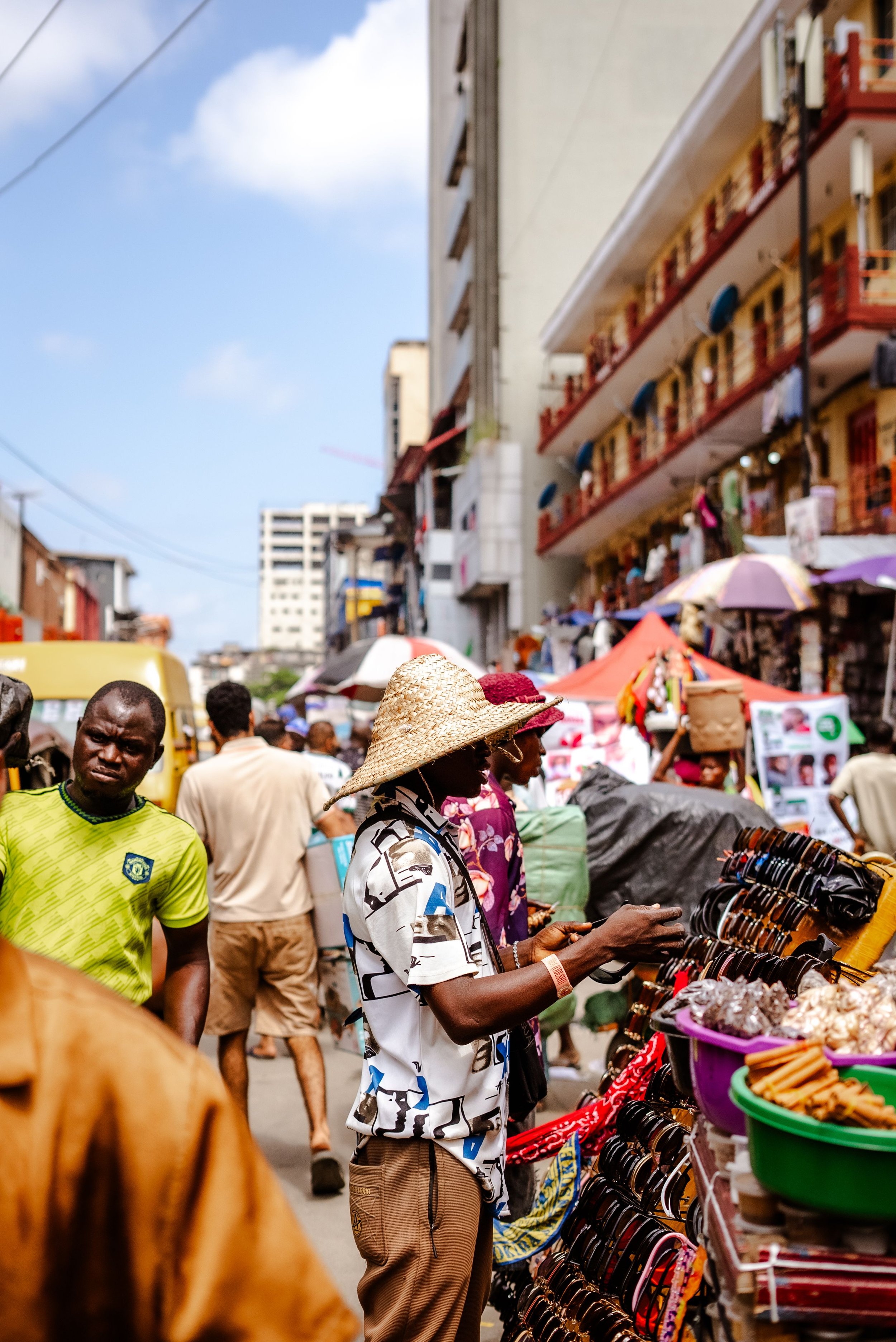
The Western development concept declares a city is only truly modern when the skies above its streets are filled with glass skyscrapers and the streets below, blanketed by towering shadows, are flush with abundant consumption.
Take for example the Gulf States, which announced their arrival to modernity with the tallest buildings in the world, a sea of LED screens, designer stores, and expansive highways filled with European sports cars.
Nigerian architect Tosin Oshinowo is not convinced. For her, development is not as a destination but “an ongoing exercise,” she said during our video call on May 13, 2026.
Tropical Modernism: Projected into Modernity
A child of the 1980s, Tosin Oshinowo was raised in a young nation defining itself in a rapidly modernizing world. Born in Ibadan, just north of Lagos, her family moved to the central metropolis shortly after where she grew up in a concrete world of tropical modernism.
Emerging in the 1950s, tropical modernism combined modernist principles with tropical vernacular traditions. “Projected into modernity,” Oshinowo says elliptically.
With arbitrary borders built around colonial systems of extraction, this modernist design was one of the first steps towards defining and developing a modern independent Africa. “It was seen as a thing of pride,” she says. “This was us being progressive, we were moving forward. This is what it meant to be African in the heyday.”
At 16, Oshinowo moved to England. She went on to study architecture and design extensively: Kingston University, University College London, Architectural Association School; and then later, the IE School of Architecture and Design (2021), and Harvard University Graduate School of Design (2023).
Her professional career is equally as robust with jobs at Skidmore, Owings & Merrill in Boston; Office for Metropolitan Architecture (OMA) in Rotterdam, and James Cubitt Architect in Lagos. In 2013, she founded her firm, Oshinowo Studios, in Lagos.
OMA’s most notable connection to Nigeria stems from their multi-year research into the urbanization of Lagos, which transformed global perspectives on megacities in the Global South. OMA founder Rem Koolhaas and his team conducted extensive fieldwork in Lagos, Nigeria between 1997 and 2001. At the time, Lagos was experiencing explosive population growth, and the research fundamentally disrupted how Western architects, urban planners, and sociologists viewed rapidly expanding cities in the developing world.
Returning to the city of her youth, Oshinowo realized that “this idea of the post-colonial African city was very much still embracing a very Western model of thinking and working – it wasn't terribly exciting.” She really began to question this model when she started her practice.
For Oshinowo, creation “comes from a series of constraints and understanding of context…I started to question this notion of what an African building was and then I realized that it probably doesn't exist.”
Though Nigeria had been an independent nation for decades, the wounds of colonialism lingered on the country’s many cultures and national identity.
Contemporary, indigenously-informed African building design and construction, she explained, “doesn't exist because we haven't followed a natural trajectory.” Controlled by external economic and political forces, the nation could not evolve autonomously and create an independent modernity.
In understanding her perspective, we must look at development not as a linear process but as contextual evolution. As an example, she pointed to African pre-colonial vernacular architecture and how its natural materiality structured life. Pre-colonial life occurred outside:
“You wake up in the morning, you get out of your little hut, you go to the farm, you come back, you sit under a tree, cooking is done externally in a communal kind of activity. The room is only for sleep, and so the room was always kept usually quite dark because you're not there during the day and you needed it to be slightly warm at night.”
However, in the 1970s when Lagos was rapidly developing, new cheap and abundant materials were needed. The solution was concrete.
The embrace of tropical modernism, she says, “was based on the understanding that concrete was not the best material for the tropics. However, if you designed it very intentionally, you could get architectures that worked appropriately for it.”
Most notably, concrete retains heat, a serious problem in the thick tropical heat of Nigeria. Construction and development managers had to take this into account. She explains: “if you're going to use concrete, you have to think about cross-ventilation, you have to think about deep-shaded windows.” With these developments, a life lived indoors was no longer a foreign concept. However, rather than be totally replaced, Nigerian community and culture adjusted to the circumstances.
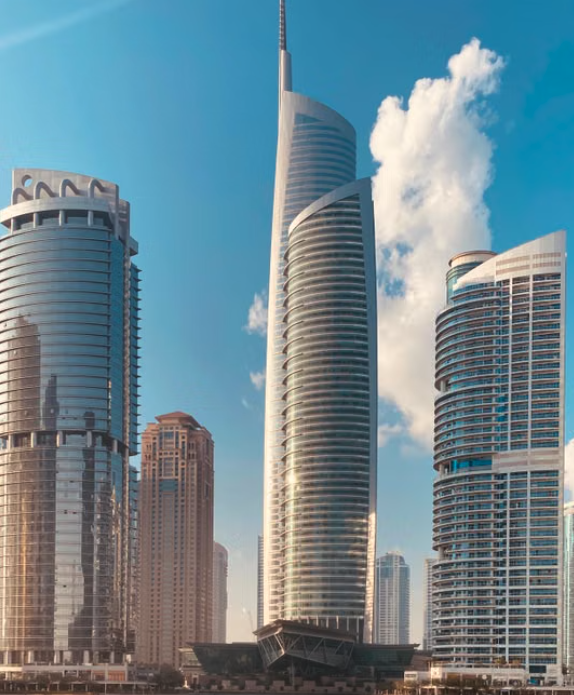
The Western ideal of modernity is brilliantly striking in design but also the epitome of various forms of plunder that fit neatly into a term that’s gained a lot of traction: “extraction.”
Glass and steel skyscrapers in Dubai, UAE.
Photo: Bandier Studio via Pexels
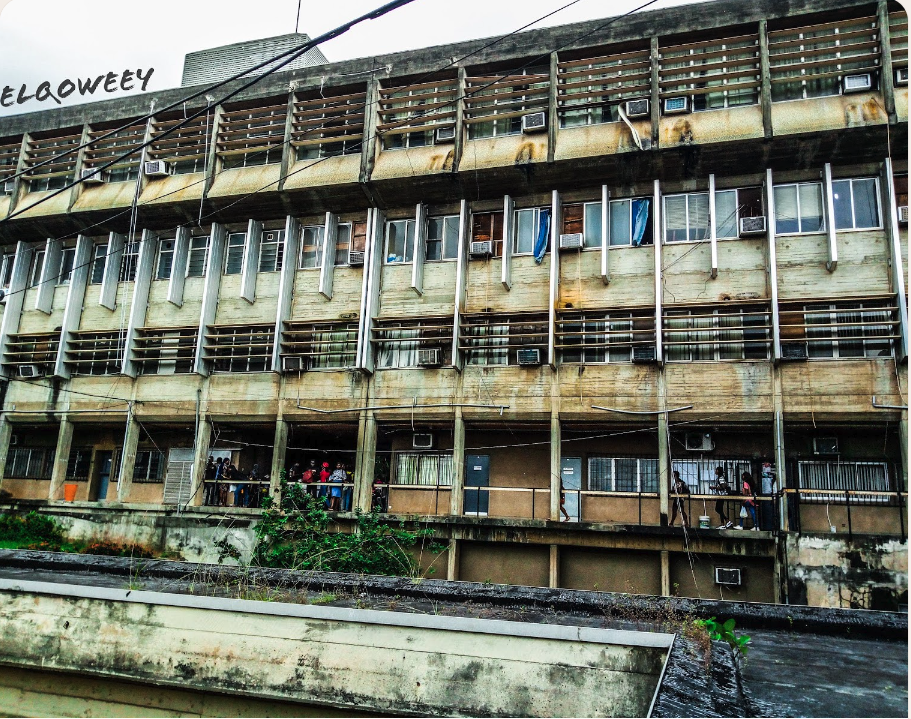
Concrete gets discolored in tropical climates. In a 2025 ArchDaily article, Mohieldin Gamal says that “climate design methods” were applied to tropical modern architecture in Nigeria, including the Faculty of Sciences building at the University of Lagos. This partial view of Faculty of Sciences is posted on the building’s web page.
Source: Omotayo Kofoworola, photographer based in Lagos Nigeria
Controlled by external economic and political forces, Nigeria could not evolve autonomously and create an independent modernity.
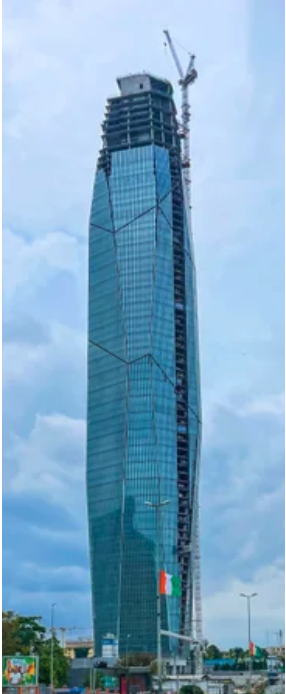
A monumental achievement in West Africa that Tosin Oshinowo does not celebrate.
Tower F under construction in Abidjan, Ivory Coast in 2025. With 75 floors, it became the tallest building in Africa when it opened in 2026.
Photo: Olem Mel - Wikimedia Commons
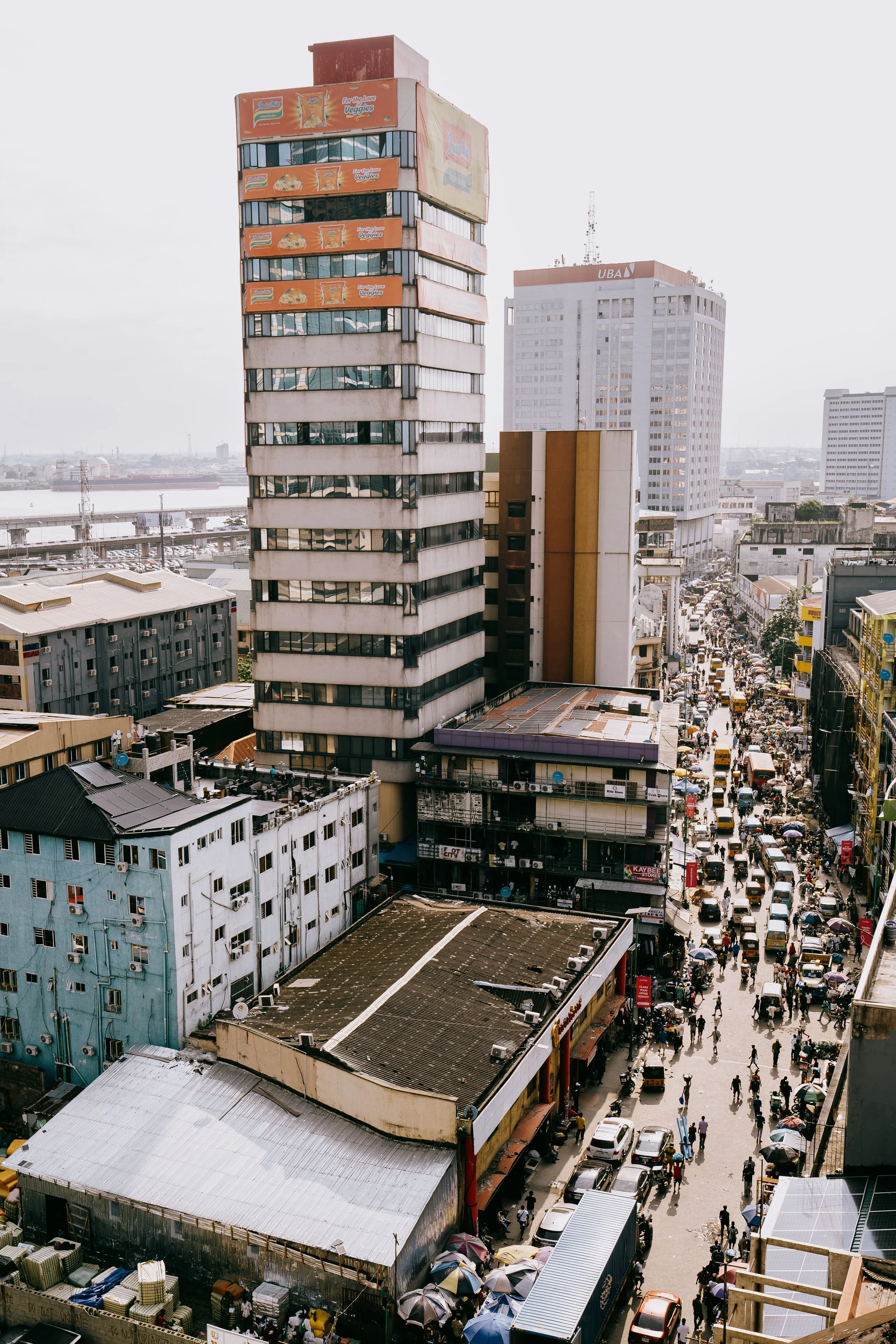
View of Lagos corporate business sector. Photo: Aminu Fahd/Pexels
Tosin Oshinowo does not view the skyscraper as an appropriate model of progress for West Africa and traces the rationale for skyscrapers to spatial constraints and other conditions specific to late 19th century New York City and Chicago. Instead, she regards repeated patterns of people arranging themselves spatially and their patterns of transactions as the essential infrastructure. These patterns should be among the key factors informing the need and design of building construction. In their flexibility, local patterns afford evolution. And in their repetition, they afford stability. This is the design thinking that Tosin Oshinowo applies to the Lagos self-organizing markets.
A climate aspect of tropical modern design did allow for natural ventilation
Tosin Oshinowo has “fond memories of being very comfortable in class because you just leave the louvered open and you get this lovely breeze that comes. And these lovely deep corridors where you have girls running up and down.” In the 1970s and 80s, this was modern Africa; how Africans lived in modernity. “Tropical modernism was foundational to how the continent could progress and the materiality of concrete, louvered windows, deep shades was very much at that forefront.”
Despite this, the destination of development had not been reached. Africa still had to progress towards a western modernity. “There's always an association with things that come in from outside as better” she says.
“The big problem was the advent of air conditioning… all of a sudden now you could make a room a fridge. All these concrete buildings which had been designed, conscious that they would be hot with the window systems designed to ensure that you were able to have the breeze back and forth.”
However, “now people were blocking them off with plywood and sticking an AC in the window. It completely defeats the purpose… But because it was associated with progress, people bought into it.”
Context gave way to convenience, intentionally to disregard. Concrete buildings, which were once built slim, became antiquated as air conditioning allowed for a simplistic uniformity where now “you can make it deep because hey, it doesn't matter. You don't need the air to go in one corner and come out the other. So it completely changed everything.”
Boom and bust oil cycles, stagnant development, and cuts to electricity subsidies have laid bare the damage caused by this form of progress as “now that it's become expensive, all of a sudden people are realizing that, I don't have a big enough window, I don't have any cross ventilation. It's very hot.”
She bemoans how air conditioning “changed the way we dress. I don't know why anyone in Nigeria is wearing a suit in a bank. It's only because there's air conditioning, so they can afford to have the temperature as if they were in Europe.”
With air conditioning, you can build the same concrete block building in India, Indonesia, Brazil, or Nigeria. Climate, social patterns, local materiality, cultural ornamentation, sustainability, and resource extraction are no longer a consideration when embracing cheap abundance and comfort. In many respects, this notion of western development does not seek to improve the conditions of one's context but to eliminate one’s context. In other words, the total adoption of the western technology did not produce a modern Africa but a western one. It forced a round African environment through a square western modernity.
Inefficient construction, unlimited extraction, and the wasteful use of resources needed to accommodate said inefficiencies has profound consequences for the climate. Today, air conditioning alone accounts for 3% of global carbon emissions. With rising temperatures that number will increase to 7% by 2050. These economic, environmental, and social costs are not an unfortunate consequence of this Western imposed progress: it is the generally believed “progress.”
The global T-shirt
An example of this so-called “progress” is the $10 T-shirt. It begins in eastern Kenya, where small farmers harvest water-intensive cotton. It then boards a diesel tanker, traveling 5,000 miles to Shandong, China where the cotton is spun, treated, and dyed with aggressive polluting chemicals. Next, it travels 1,800 miles to Dhaka, Bangladesh where sweatshop workers making pennies cut the cloth and sew the shirt. The now completed T-shirt travels 7,700 miles to the United States where it is offloaded and driven to a regional distribution center. Finally, our well travelled T-shirt ends up in a shiny glass building or drab box store hanging on the rack of a fast fashion retailer. Someone buys it for a mere $10 dollars. A steal right?
Quickly, the novelty wears off as the edges of the poorly made shirt start to fray. It is bagged with the rest of the forgotten clothes from the back of the closet, brought to a charity shop, and (hopefully) shipped off to some presumably needy person in Africa. More often though, cheap shirts and other manufactured commodities end up dumped on beaches in ‘developing’ nations where the waste pollutes and people scavenge through it.
A modern marvel, no? Centuries of industrial and technological development culminating to create a global network built on such meticulous levels of coordination, extraction, and production that until very recently were impossible. Labor and resources pulled from dozens of countries, tens of thousands of miles travelled, many thousands gallons of water, chemicals, and diesel consumed and in a few short months the T-shirt is without value. However, it was only $10. You can always buy a new one.
For Oshinowo, this version of ‘progress’ reveals a "buzz of development" driven primarily by imperial exploitation. Colonial infrastructure wasn't designed to serve local populations; rather, it was built “primarily to move goods from the hinterland down to the ports” for export.
Though the age of formal empire is over, its developmental legacy persists. Today's "global capitalist system," Oshinowo notes, still relies on siphoning resources "from one area to the other to develop a core." This asymmetric model of funneling raw materials outward to sustain modern comforts like cheap T-shirts and abundant air conditioning has wrought catastrophic environmental harm, disproportionately threatening those with the least.
Already burdened by pollution and infrastructure unable to match the population boom, Lagos in the coming years will bear the brunt of sea-level rise, flooding, and ecosystem degradation. The existential threat of climate change demands a new understanding of development. The conventional wisdom of top down capital investment towards large infrastructure projects, economic growth, resource extraction, and endless technological integration and consumption are unsustainable. What then can we learn from Lagos? What does progress look like in this city of the future?
The truth is there is no single answer. In our conversation, Oshinowo admitted she is not “providing an alternative because I don't have one yet to provide.” Despite this, “I am flagging alarmingly that it does need to change.” Responding to that alarm, this platform is providing support in seeking answers.
Today, she continued, “everyone’s still running on how much do we have? They are business models that are built on the rationale that every time you come into the store there's something else to buy…. Why is it that your iPhone by year two the battery's dead? You know, the redundancy is built in. Africa becomes a dumping ground.”
In the fast fashion stores and overflowing closets of the West, the $10 T-shirt has little value. Ultimately, it is worth less than the resources and labor expended to create it. However, in the markets of Lagos it may have endless value. “What Africa has shown is that it is possible for cities to exist in a different way,” she said. The bustling maze of the markets offer one answer to the question of what development might look like in modern Africa.
The open markets of Lagos are “changing our understanding of the value of things”
The $10 T-shirt and endless air conditioning are built on fitting a locality into the global economy, demanding a top-down structure of international capital, resource and labor exploitation, and endless consumption. In contrast, the markets of Lagos develop to fit a globalized economy into a locality, predicated on self organization and localized need. They are an active project, “changing our understanding of the value of things,” says Oshinowo. It is the adage that one man's junk is another’s treasure scaled up by self-organizing ingenuity to create a system of international trade and reuse.
The “value” generated by the Lagos markets can be understood as a form of what socio-technical action researcher Kwame Porter Robinson, Eglash et al. discuss as generative justice in their 2025 paper, Computing for community-based economies: A sociotechnical ecosystem for democratic, egalitarian, and sustainable futures in the journal, The Information Society:
“As opposed to the western neoliberal theory which “assumes money to be the universal representative of value… . Generative justice applies a value distinction across three domains: ecological, labor, and social.”
Within the parameters of generative justice, “sustainable systems return, or circulate, value back to their sources and crises are created when value is expropriated with little return to them.” These localized circular economic and social systems are what the authors identify as unalienated value, which is “recursively defined as that which makes possible just and sustainable value generation.”
The authors differentiate generative justice from other theorizations with the emphasis that egalitarian interaction should proceed bottom-up and across social, ecological, and labor domains:
“Firstly, the participants organize themselves across the full cycle of value generation and circulation; and secondly, the value remains within the participant community and while it can be shared the value is not expropriated away. In the unalienated form, cyclic generation, sharing in self-generated value, is a kind of unalienated value whereas extracting self-generated value by not sharing in its creation—the alienated form of value—can break egalitarian cycles.”
The 2025 "Computing for community-based economies" paper cited above is an offshoot of interdisciplinary scholar Ron Eglash's seminal thesis, An Introduction to Generative Justice (2016). In Eglash's University of Michigan course based on this thesis, students developed hands on projects: designing with ecologically sustainable materials, enhancing labor value for an artisanal economy, merging arts with computing and working with community members on a collaborative final project that explores designs for generative justice in real world contexts.
Ron Eglash’s generative justice principles extended to Ghana in 2019.
In January 2026 Ron Eglash and his partner, Audrey Bennett, published the paper, African Interlace as Dynamic Grids: New Heritage Algorithms for Diaspora Design Ecologies.
African interlaces are continuous “over-under” paths symbolizing circulating vital energy. They function as “dynamic grids,” blending fixed shapes with flexible, flowing relationships. This conception can be applied to architecture and city planning.
A vital part of Lagos 2050 planning also involves design concepts for urban agriculture and national food cultivation and distribution. Audrey Bennett and Jennifer Vokoun map details and provide graphics for this kind of development in Critical Mapping for Sustainable Food Design. Read more about Audrey Bennett’s research in this Ecollective article.
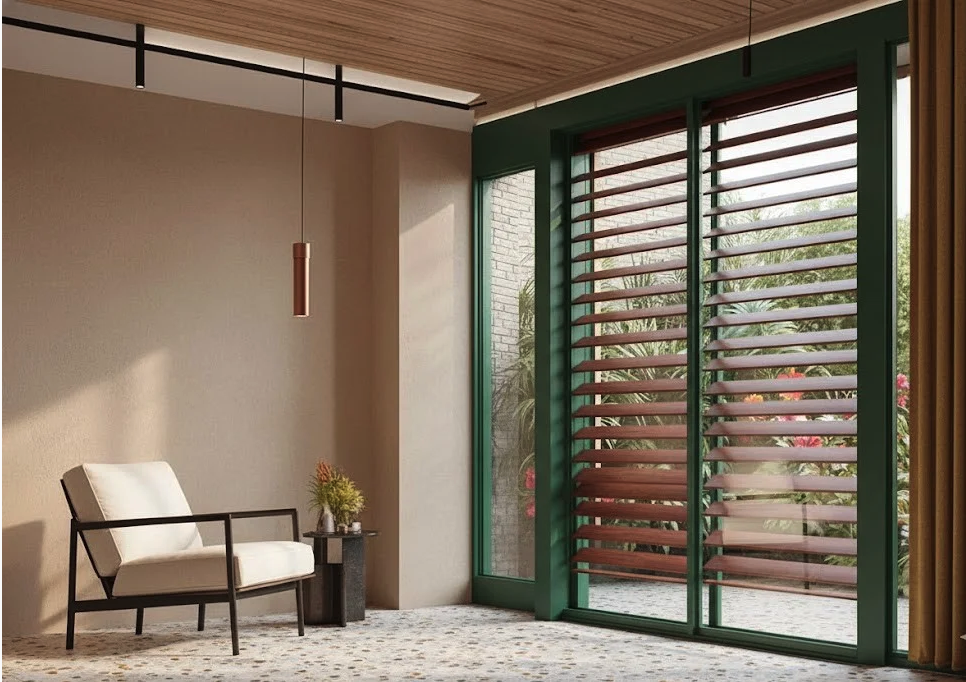
Louvered windows facilitate natural cross ventilation in the tropics. Source: Oridow windows catalogue
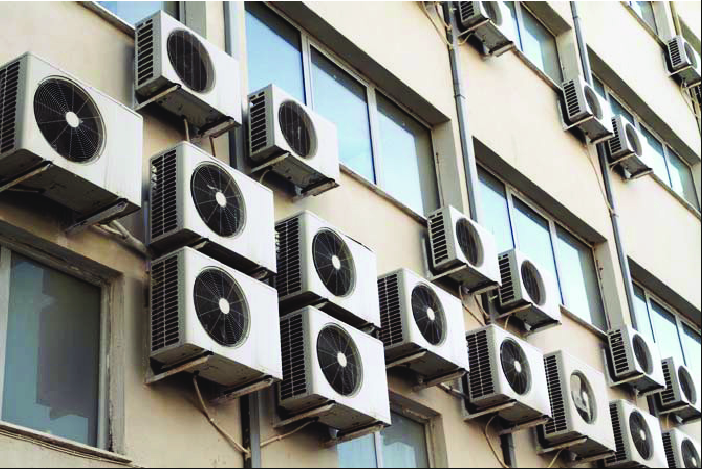
Air conditioning allowed for a simplistic, context-less uniformity dependent on expensive energy. Source: ResearchGate
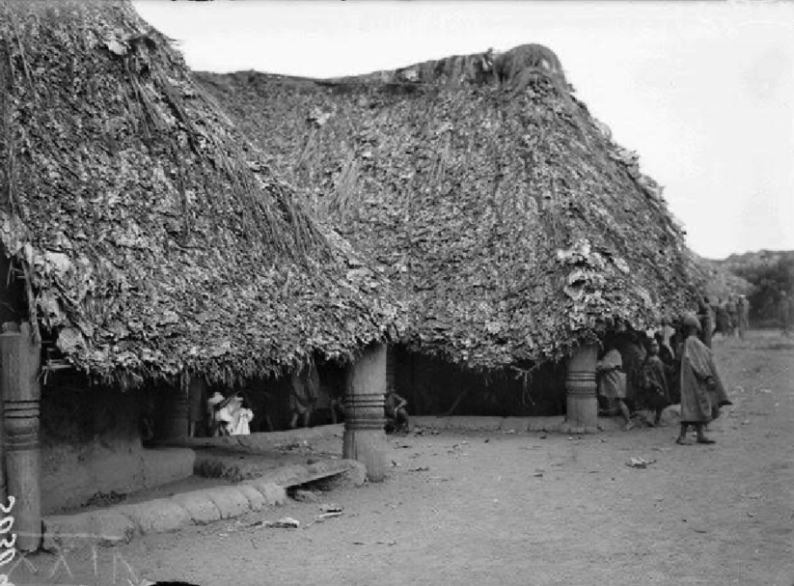
A building on Lagos island in the traditional style source: researchgate.net
Traditional “earth houses” (made entirely of locally-gathered elements from the Earth) and, this one with hand-carved columns, are prototypes of natural beauty that can be adapted by architects like Tosin Oshinowo who affirm an aesthetic of “impermanence.” Replacing deteriorating plant fiber roofs with more of the same is enduring life within the impermanency of earth houses. Photo: Luqman Owamoyo, Baharak Tabibi
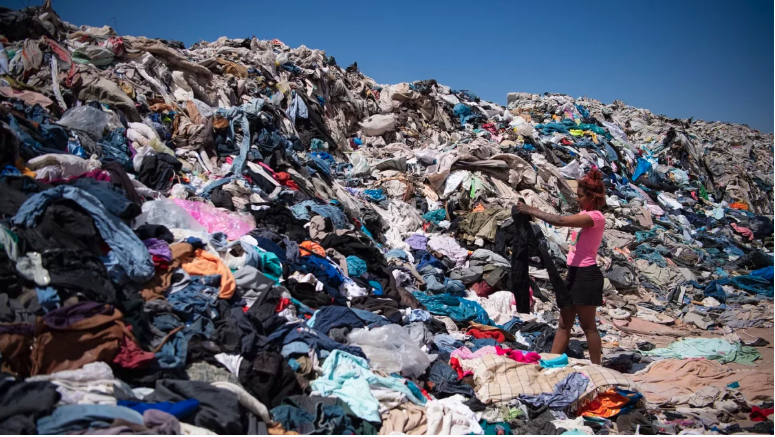
Fast fashion epidemic dump
Source: UCLA Sustainability report
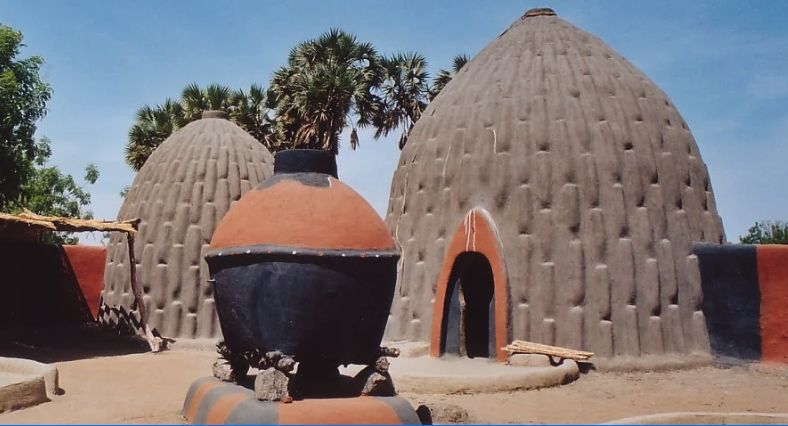
West African village clay pottery techniques can combine with contemporary building construction.
Shell shaped edifices in Cameroon.
Photo: Wikipedia
“With reuse and adaptation, the Lagos markets are very sustainable, they use very little energy, they are moving volume — volume — and they actually tie into global logistics because all of these traders have connections with other parts of the world because Lagos is a port city.” — Tosin Oshinowo

Source: Omotayo Kofoworola, photographer and performance artist based in Lagos Nigeria via pexels
Olusosun dumpsite in Lagos is the largest in Africa and one of the largest in the world.
This boy highlights Tosin Oshinowo’s point about Africa becoming “a dumping ground,” devastating the waterfront, and yet a source of recycled “value” though the Lagos markets.
This essay continues below the charrette section.
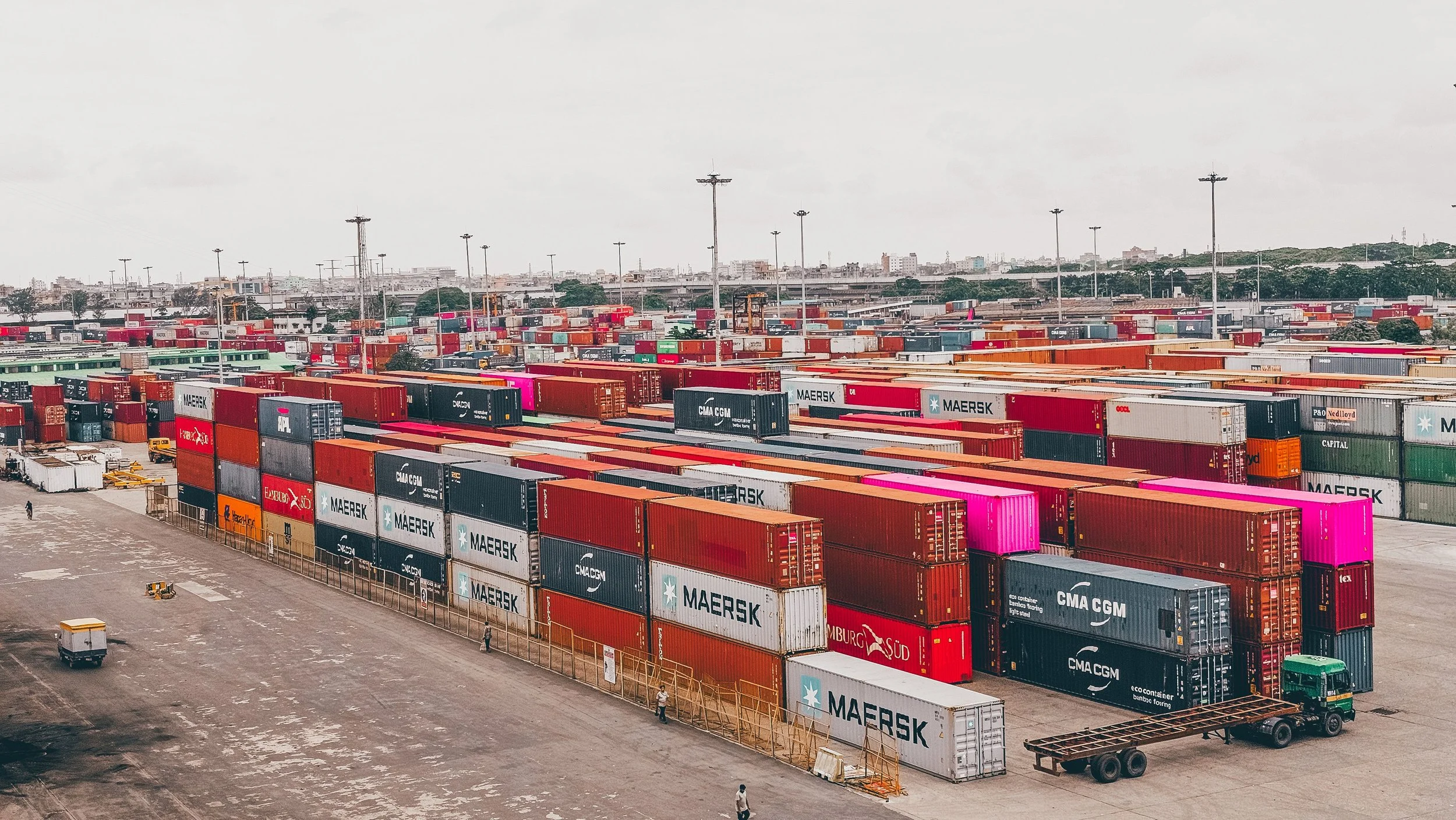
Shipping containers at Lagos Nigeria port.
Source: Md Sihabul Islam/pexels
Below: A view of generative justice in action in Kumasi, Ghana.
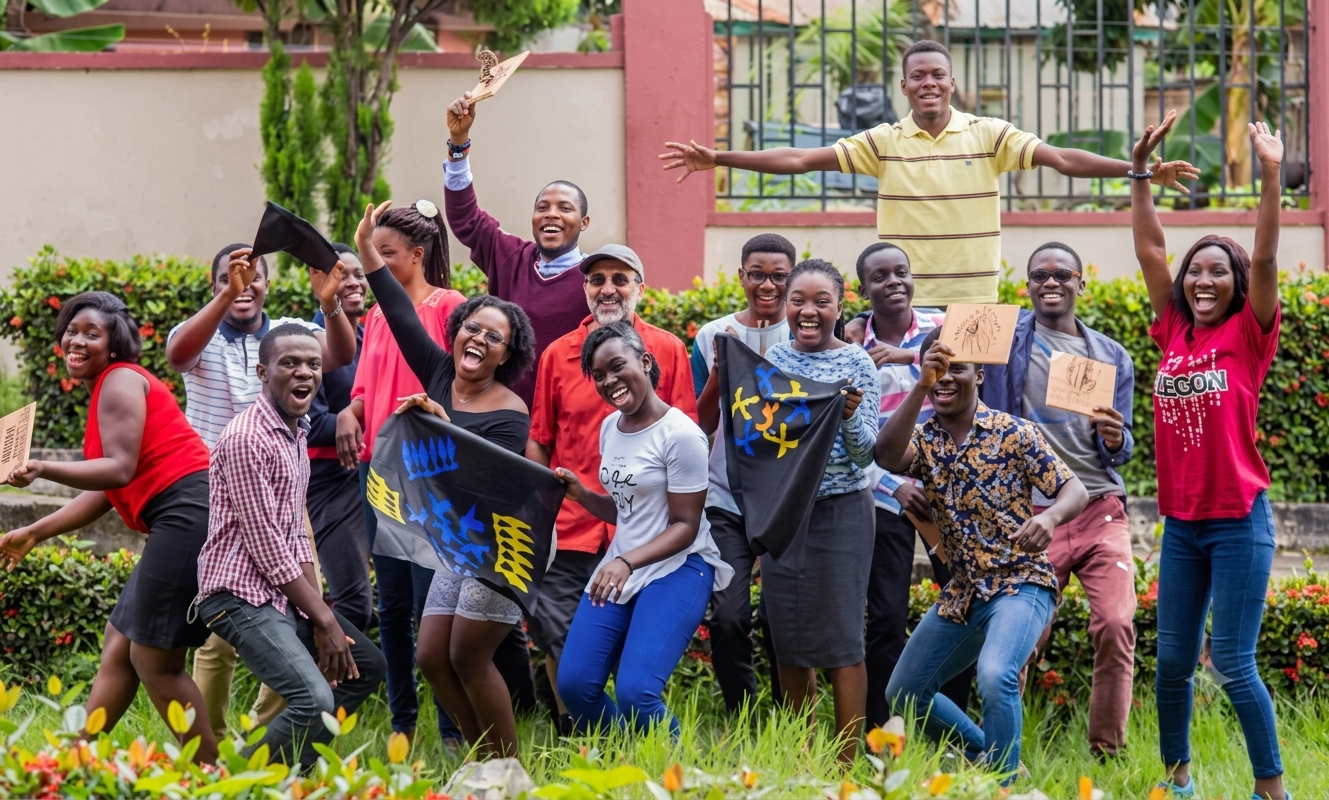
Students in Ron Eglash’s University of Michigan course worked with the Kumasi Creativity Group of artisans and entrepreneurs to explore “what it means to build — and keep — value in a community.” Shown here are Creativity Group members with Eglash during his 2019 visit to Kumasi. (Photo courtesy the Creativity Group)
Lagos 2050 virtual charrette. How Africa can lead into the mid-21st century.
An charrette is a collaborative design process to resolve problems and map solutions. This charrette is aimed at supporting Tosin Oshinowo’s conception of “Lagos, the city of the future” and, more broadly, the conception of the Global South as a crucible for socially and environmentally responsible development in a multi-polar world.
Nigerian and international professionals and students in architecture, engineering, community-based economics, information technology, visual arts, crafts, anthropology and other disciplines that resonate with this project are invited to participate in the charrette. Their mission will be to envision how social systems and the above-cited professional and craft disciplines can combine indigeneity and universal best practices in Lagos and other areas of the Global South. While the participants should be informed by Oshinowo’s philosophy, their suggestions do not have to reflect every element of it. Together, their suggestions can help fulfill her vision along with their own perspectives.
A gallery grid in this space will display the charrette participants’ concepts.
Tosin Oshinowo focused the global design conversation on regeneration and resourcefulness in curatingThe Beauty of Impermanence as the theme of the 2023 Sharjah Architecture Triennial in the UAE.
The participants from 26 countries responded to this question:
How can we consciously and empathetically explore the built environment through austerity to provide a more equitable solution across Africa and the southern world ?
By focusing on solutions rooted in indigenous knowledge, localized materials, and climate-responsive methods, Oshinowo’s exhibition offered inspiring models for the future in architecture.
View the Beauty of Impermanence installations and accompanying text here.
The essay portion of this article continues below.
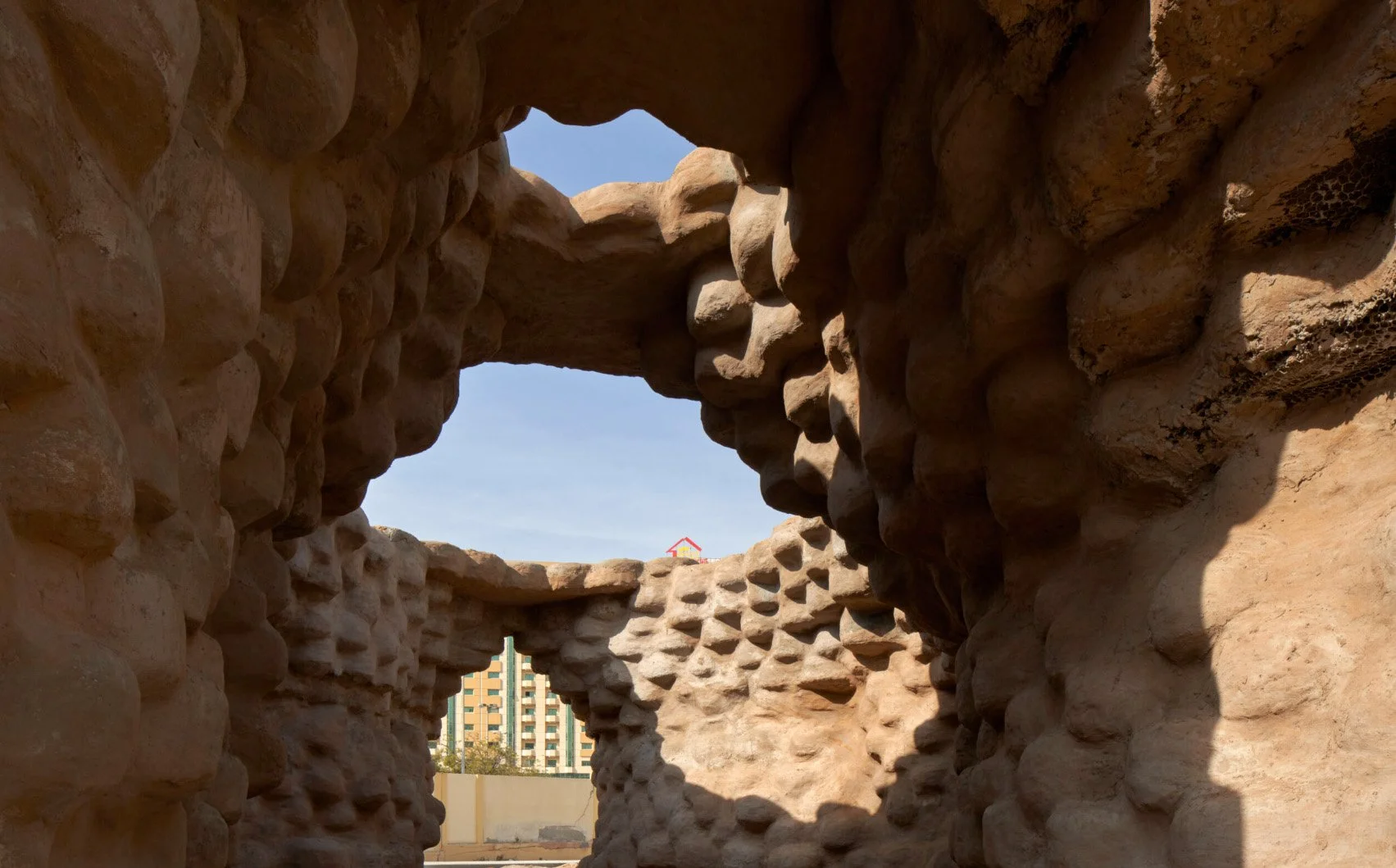
Photo from The Beauty of Impermanence
Towards Lagos 2050
We can see generative justice principles and unalienated value in the self-organized markets of Lagos. While their material shape and operation seem disorganized and inefficient, it is “not complete chaos, but it's also not visible to the eye. Maybe it's a question of looking at it with a very different lens” she told me before adding, “because it doesn't follow the trajectory that you would expect to see development to happen.”
Corporate commodification demands endless cycles of consumption; the previous season’s collection must always be thrown out for the new. In contrast, the self organized Lagos markets operate not to extract and consume but adapt and reuse. “We get a lot of the things that are sold in these markets through the port. So they do follow formal channels up until the border. Then there's this secondary system that goes in and takes over.” Despite lacking fixed prices, permanent indoor structures, and access to global capital they are able to meet not only demand but scale. Because of this they're “very sustainable,” she explains. “They use very little energy, they are moving volume, and they actually tie into global logistics. Because all these traders have connections with other parts because Lagos is a port city.”
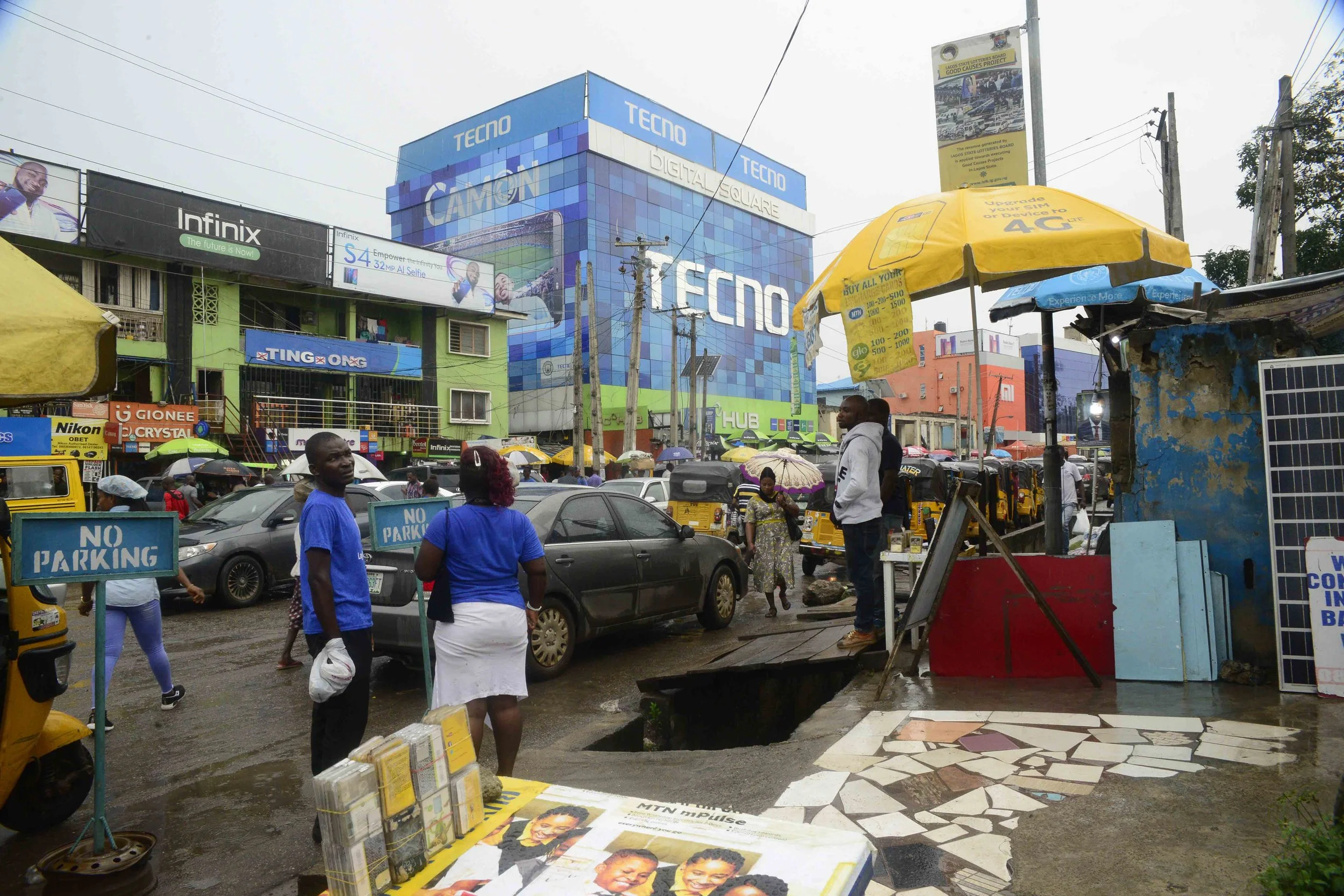
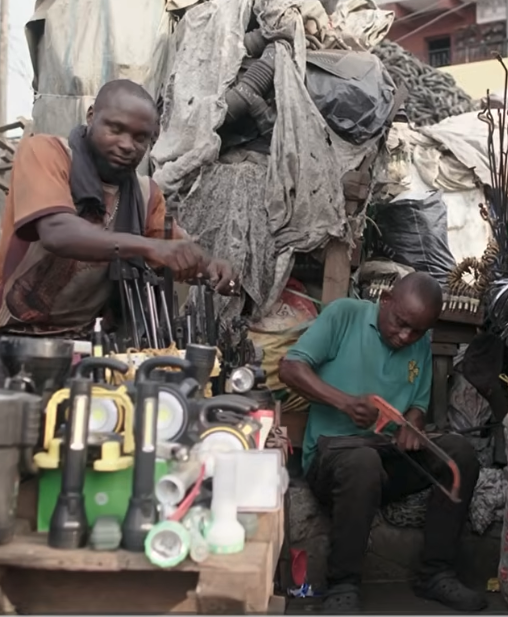
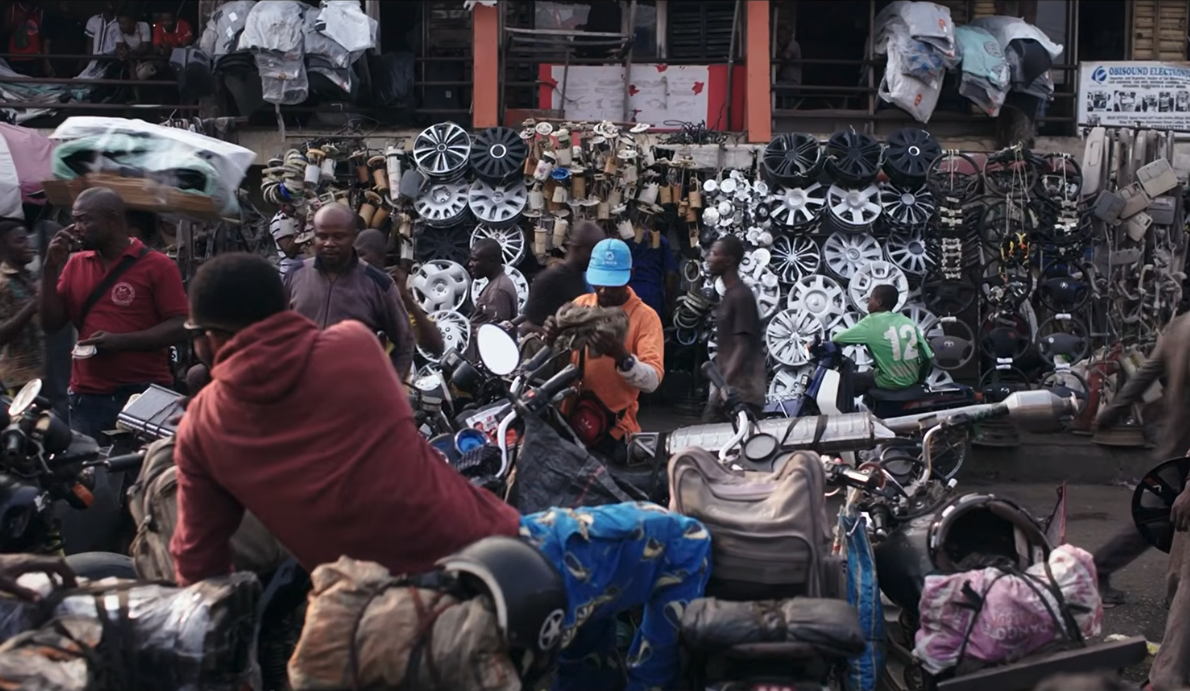
The localized system does not preclude vendors, importers, and buyers from embracing modern technologies or global integration. Take for example the electronics market: Computer Village, Oshinowo says “on an average a day, they make 2.5 million dollars in sales of electronics. They can do everything there, they can fix your phone, any phone, anywhere that's not working. They can make stuff, they can couple stuff, they have new, they have old, but it's a massive convergence point.” Furthermore, The computer market is integrated into established global channels such that “the big multinational companies who sell electronics have understood that if they have presence in this market, they have the whole of Nigeria. And a lot of people in West Africa come to this market to buy.”
Western wisdom suggests that these markets are not modern, evidence of a country still struggling to maximize production and consumption. And yes, these markets are not modern by western standards as Oshinowo notes “we probably have closer to the medieval market” because they “have no fixed price.” But she insists we embrace a modernity that is contextual rather than global.
In the West, development is measured through access to global channels of capital and the formalization of economic exchange and social organization negotiated by said capital. It seeks to create a life of excess and ease that occurs inside. Development within a Nigerian context looks quite different. For example, “maybe three people will decide to be efficient and join three clubs together and build something a bit taller, and then they have an organizational system. They have a system of creation to develop themselves.”
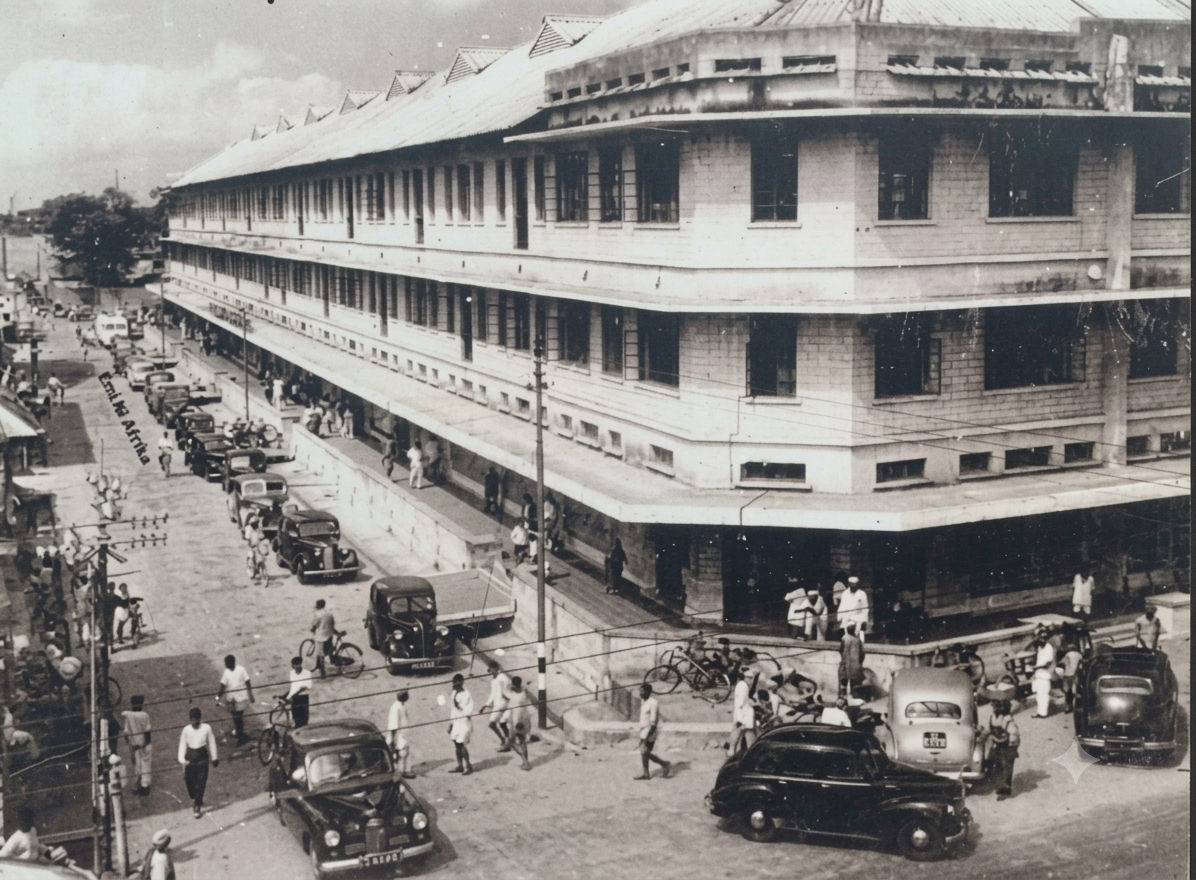
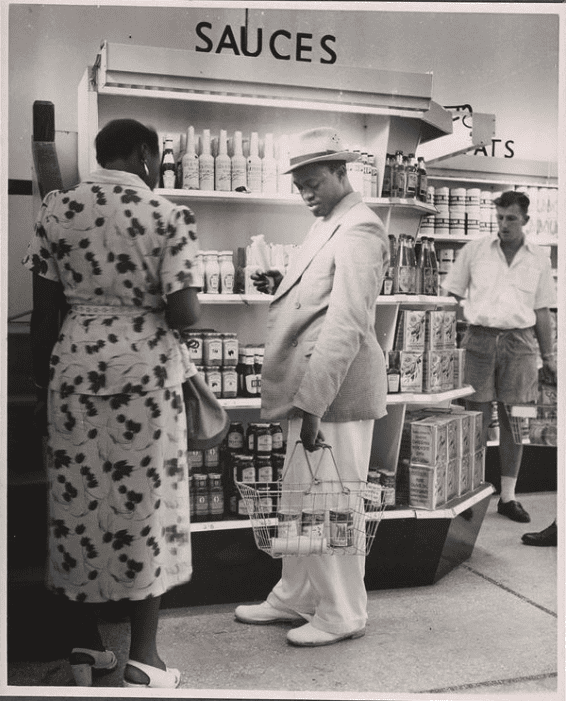
Attempts at imposing “conventional” development on Nigerian markets have been attempted. One notable example was the first. In 1948 Kingsway Department store opened. Owned by the United Africa Company, a British colonial company and a subsidiary of Unilever, it was an attempt to bring Europe to Africa and Africa to the modern world. “Kingsway leads the way to modern living” said a 1960 advertisement. However, by the 1980s the experiment had failed. Falling oil prices and IMF imposed financial reforms made the importation of western commodities unsustainable and shopping cost prohibitive for the majority of Lagos residents who still preferred the local outdoor markets. Attempts in the early 2000s saw similar failures. Today, Oshinowo says, the Nigerian federal government once again is attempting to formalize the markets. Approaching their vendors and organizing bodies insisting that “We want to modernize…we wanna build you a building.” Yet, “These guys did not ask you for a building. They are fine working in these converted houses that they've been able to reappropriate.”
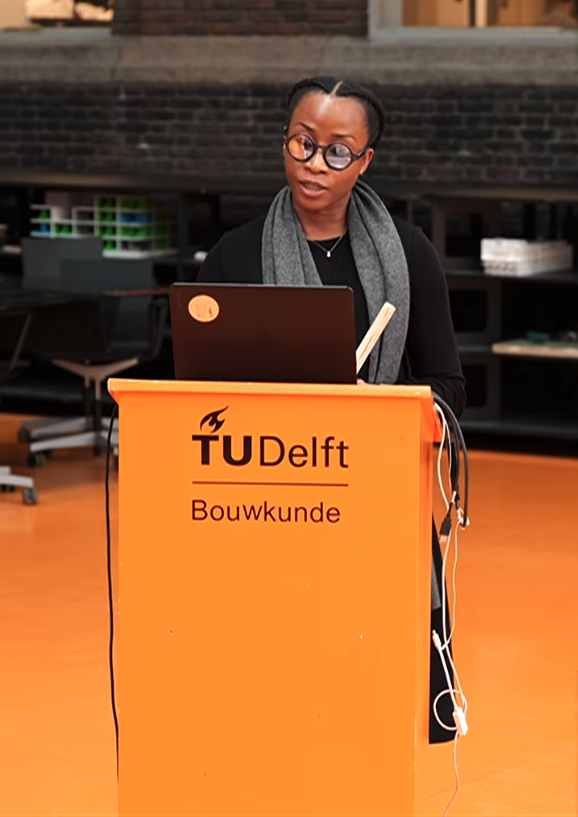
Tosin Oshinowo at the Technical University of Delft, Netherlands, April 20, 2026
Notes about the Kingsway Department store photos reproduced above. The photos appear without source credits in Simplvest, an online Nigerian business digest. Original source of photos, not found.
Below: views of Kingsway Department store in colonial-era Lagos
View of Computer City, Lagos, Nigeria. Lightfast Media - Own work, CC BY-SA 4.0
At the heart of these failures is the effort to produce economic metropoles of consumption and tertiary sights of extraction. It is the idea that consuming a polyester product at the mall, which only depreciates in value, is an advancement from buying cotton cloth at Balogun market from which you can create value. The markets and their bottom-up organization do not come without challenging questions:
How to integrate localized digital and financial tools that keep economic value within Lagos market communities? How to scale-up to effectively accommodate the city’s population boom? Address pollution and waste? Ensure worker protections? Facilitate a domestic manufacturing sector to alleviate Nigeria’s dependence on imports Incorporate climate-resilient, passive architecture to manage tropical heat without relying on costly energy grids? Protect vendors from displacement and gentrification caused by top-down "modernization" projects? Formalize market associations into municipal planning as active co-designers of urban space? Provide health, safety, and social safety nets suited to non-formal, self-employed workers? Safely scale local repair, upcycling, and e-waste recycling ecosystems to minimize hazardous environmental impact?
Despite these current and future questions and challenges, Oshinowo says “so much is working that we don't value…Instead of bulldozing it and thinking we need to bring some shiny new capital intensive intervention, we should be actually looking at making it work more efficiently.” These efficiencies can take many forms. For example the above-cited "generative justice” research of Kwame Robinson and co-authors emphasizes computation and eco-friendly technological integration as a way of empowering already-existing localized economic and social networks.
At the end of our talk, Oshinowo reinforces her point about local, contextual ingenuity and evolution. Is the capital and resources required to produce Western development necessary when they create systems with more waste and less longevity than their indigenous predecessors? The modern marvel of Kingsway ultimately died while the “medieval” markets live on. “The market is our most sustainable retail model. It was there before imperialism, it is there now… Why change it?”
The inherent quality of self-organization affords the “medieval” markets great flexibility to adapt to both internal and external forces and evolve in their own natural ways.
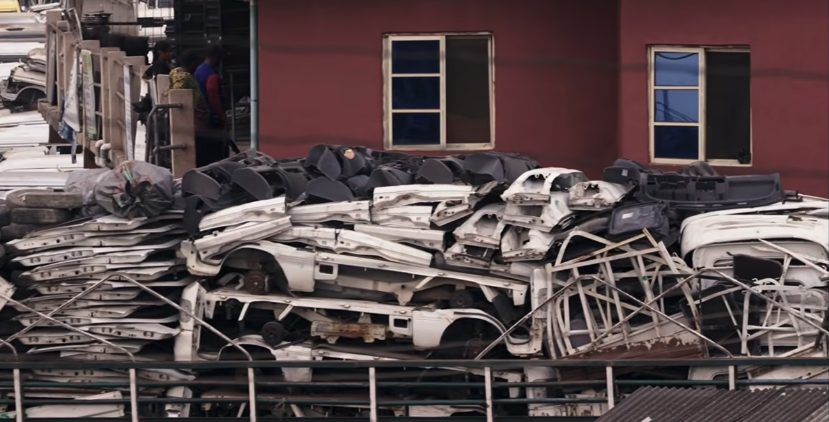
Views of the Lapido automotive markets from Oshinowo’s lecture video.
Zack Littlejohn is a New York City-based organizer who writes about political culture, community and environmental justice.
His previous Ecollective article is Monica Sanders confronts the digital divide and environment disaster.
Scroll down for final section.

As the 2026 Delft Oosterhoff Visiting Professor, Tosin Oshinowo emphasized the need for equitable urban design solutions that affirm impermanence, local context and scarcity rather than relying on Western industrial standards.
Scarcity can provide constraints that help drive innovation. And, conversely, too many choices can lead to stagnation.
She also discussed her entry at 2023 Sharjah Architecture Triennial exhibition which challenged conventional definitions of sustainability and showed how pre-industrial and communal traditions prioritize long-term balance with the natural world.
Other key points included how historical extraction (from the transatlantic slave trade to colonial-era resource exploitation) has systematically disadvantaged African infrastructure which was designed to export resources rather than support internal growth.
“people as infrastructure”
In discussing the African markets, she said they function as powerful, generative social technologies where "people as infrastructure" provide organizational functions that formal physical infrastructure might otherwise handle.
Mindful that Africa's population and urban economies are projected to grow rapidly by 2050, Tosin Oshinowo’s overall lecture at Delft advocated for design practices rooted in existing transformations and adaptability, urging a shift away from top-down urban planning models.
The Tosin Oshinowo lecture at Delft can be viewed here.
Video advisory: the auto-dubbing on the voice track of the video is filled with glitches and the superimposed text also is faulty. However the content is as compelling as it is edifying and viewers can get a solid comprehension of presentation’s key points.
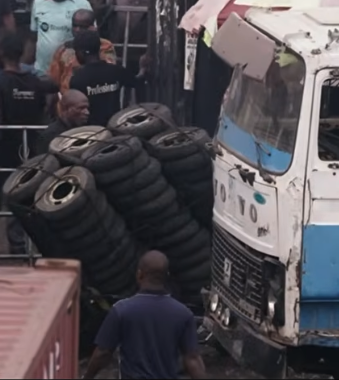
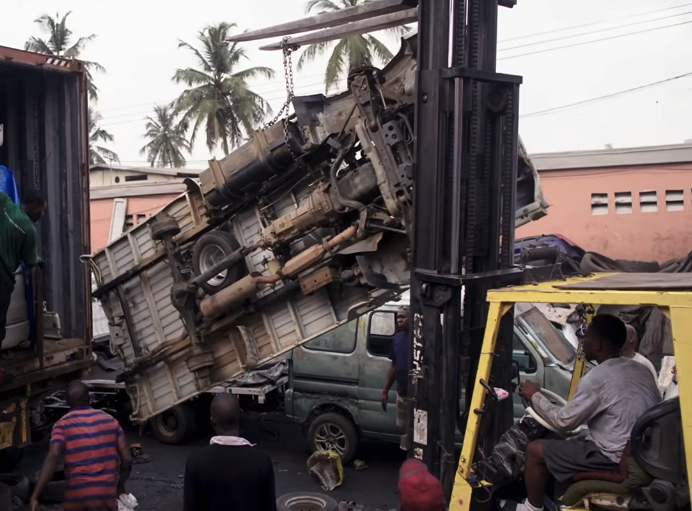
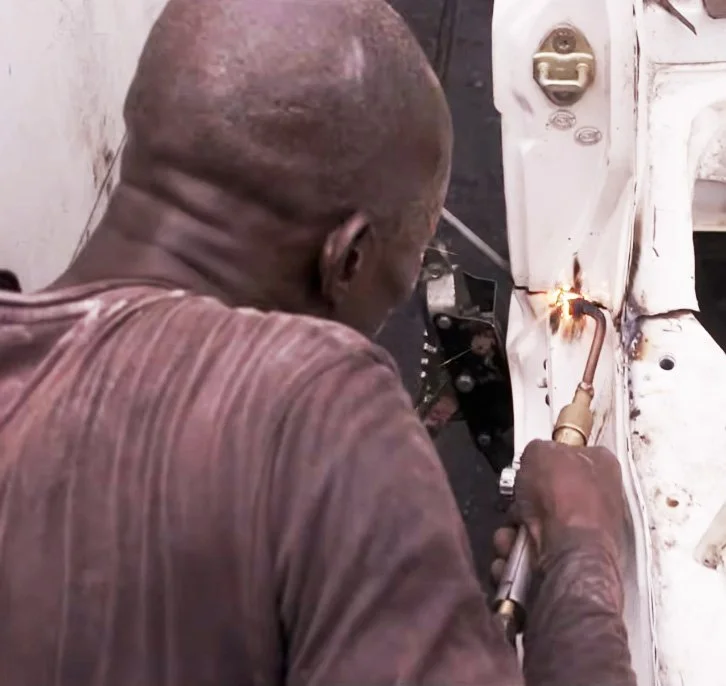
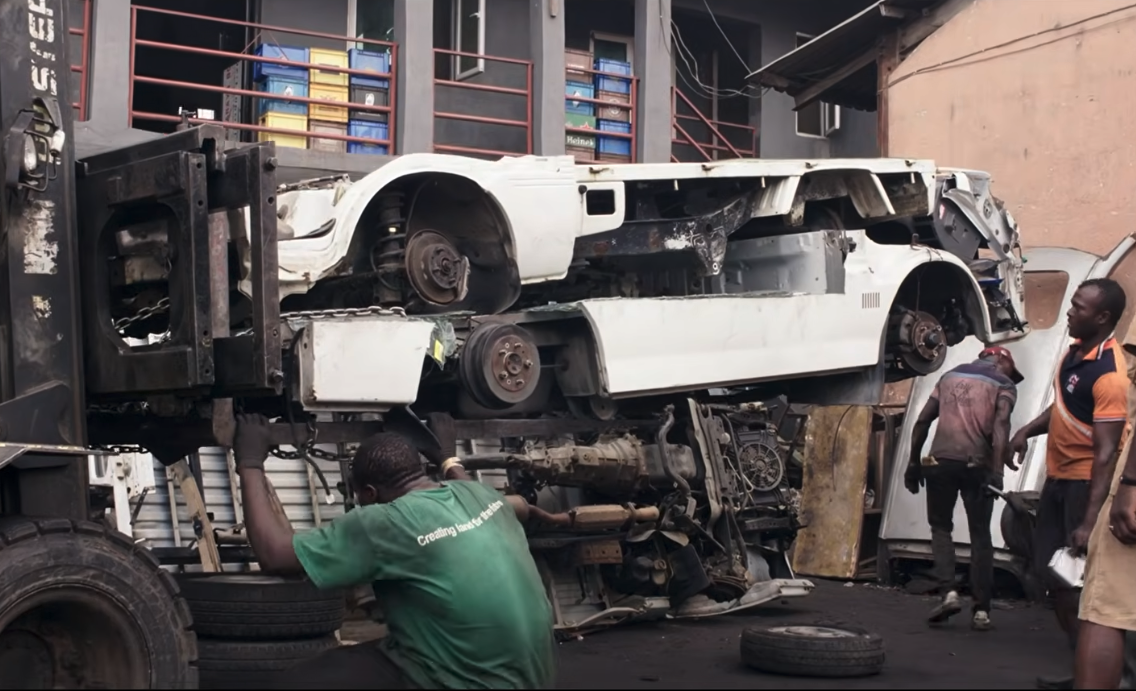
The Lapido Market in Lagos is another example of upcycling products and recycling value.
Lapido specializes in used automobiles.
View of Lapido Market, Lagos, Nigeria, from the Power Point presentation by Tosin Oshinowo in video linked below.
Epilogue
Decentralizing the megacity
The case for managed density in Lagos 2050
Any radical reimagining of Lagos must confront a fundamental physical constraint: hyper-density on fragile coastal terrain. Historically, the rise of the coastal megalopolis was an economic necessity. Ancient and colonial trade routes demanded concentrated ports of entry, maritime transit corridors, and centralized civil engineering works that could only be financed and maintained in dense urban hubs. Millions gathered at the water’s edge because proximity to the shoreline was the sole gateway to commerce, power and shared infrastructure.
By the mid-21st century, these circumstances will have greatly shifted.
In Lagos 2050, a city leading the way into the mid-21st century, high-speed connectivity, distributed clean-energy microgrids, and localized fintech ecosystems have decoupled economic opportunity from physical port proximity. Knowledge work, creative enterprise, and decentralized manufacturing no longer require workers to pack into coastal choke points.
Lagos faces compounding climate vulnerabilities: rising sea levels, storm surges and severe land sinking into the waters. Strategically redistributing population density relieves immense structural pressure on coastal wetlands and overstressed civil drainage systems, giving the natural environmental ecologies room to heal and act as a living storm buffer.
Rather than treating surrounding towns and interior regions as mere resource extraction zones for the metropolis, the 2050 vision should champion a polycentric network of self-sufficient, culturally rich secondary cities and towns. These regional hubs can integrate circular bio-agriculture, regional light rail, and indigenous building traditions without inheriting the gridlock and acoustic overload of hyper-dense urban cores.
Urban vitality is not measured solely by sheer demographic mass, but by breathable public commons, localized food sovereignty, and shorter commutes. Managed de-densification allows Afro-minimalist design principles to flourish at a human scale, favoring passive cooling, courtyard ventilation, and communal green spaces over unmanageable high-rise sprawl.
Leading into the mid-century requires acknowledging that the city of the future is not an ever-swelling monolith but a distributed constellation of thriving communities connected across land and the cloud.
Decreasing population density should also be a priority for megacities in other parts of the World.