
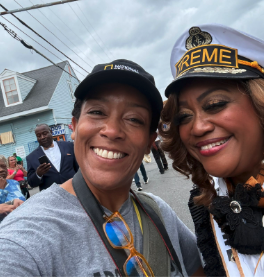
As environmental disasters increased, Monica Sanders (left) was motivated by the devastation of the Hurricane Katrina to start an organization that empowers vulnerable communities
Credit: Sanders collection. (She is shown here post-Katrina with her former high school teacher.)

Katrina at its peak intensity, south of New Orleans on August 28, 2005. Credit: NOAA (National Oceanic and Atmospheric Administration)
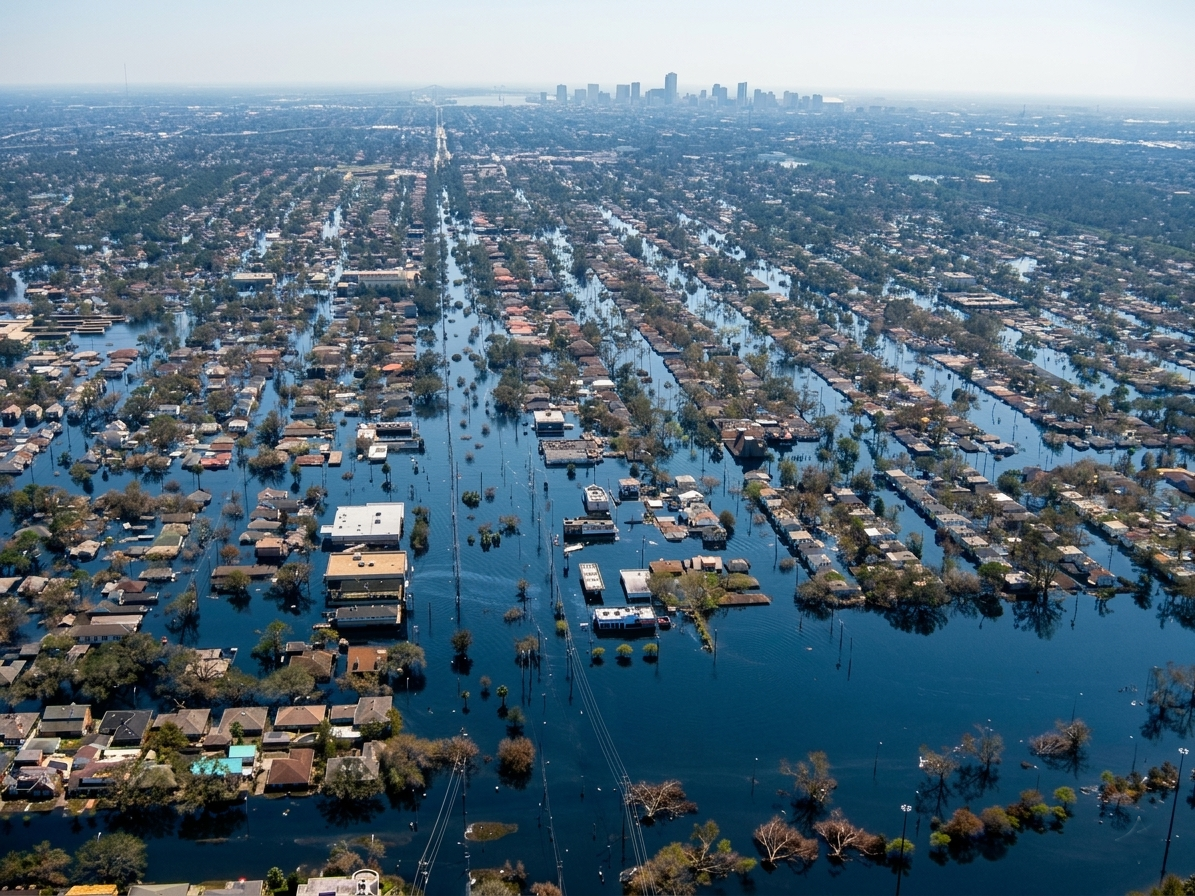
Aerial view of New Orleans after the levees broke.
National Oceanic and Atmospheric Administration
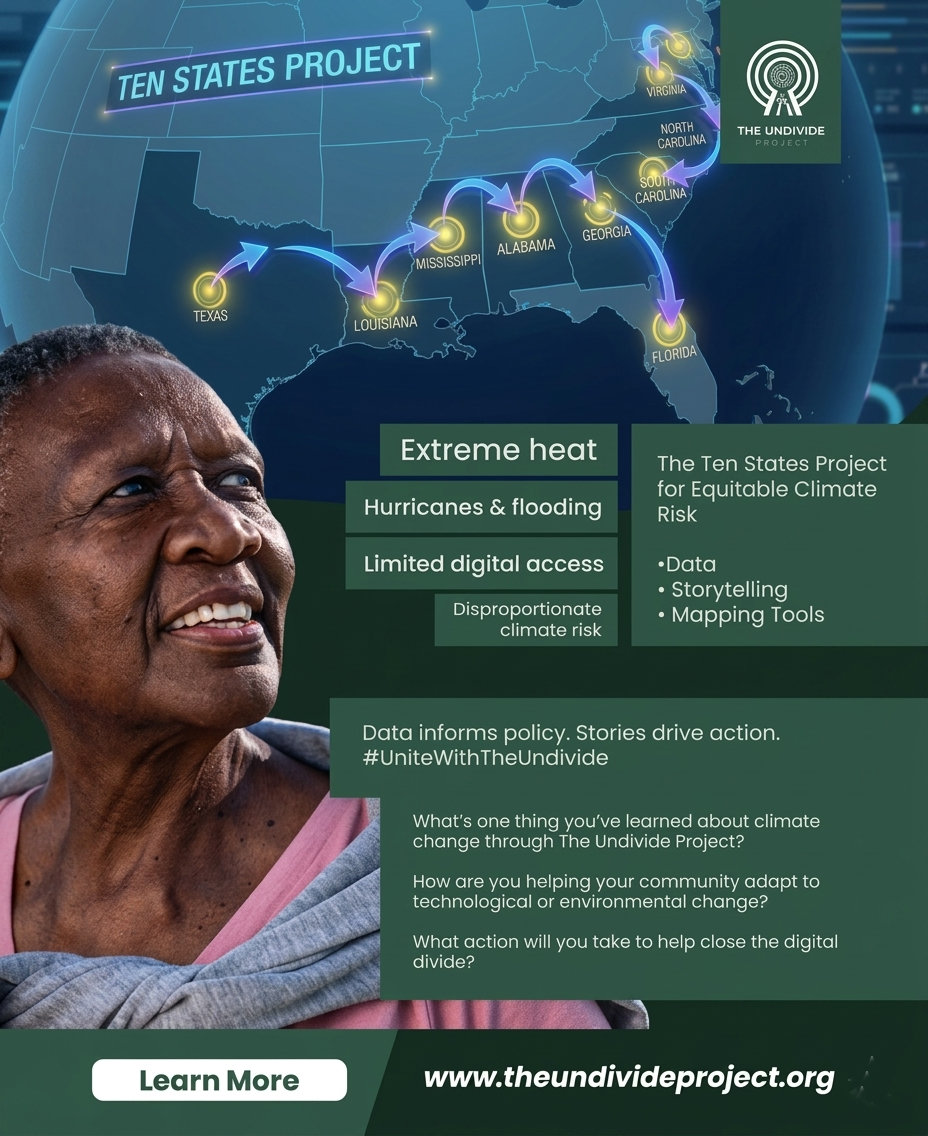
Monica Sanders founded and directs the Undivide Project which has multiple components: the Ten States Project, Grinnell Social Innovator, GEV Dashboard, community programs ranging from cooling down urban heat islands to prepping for natural disasters; policy advocacy (Sanders is an attorney) and storytelling documentation.
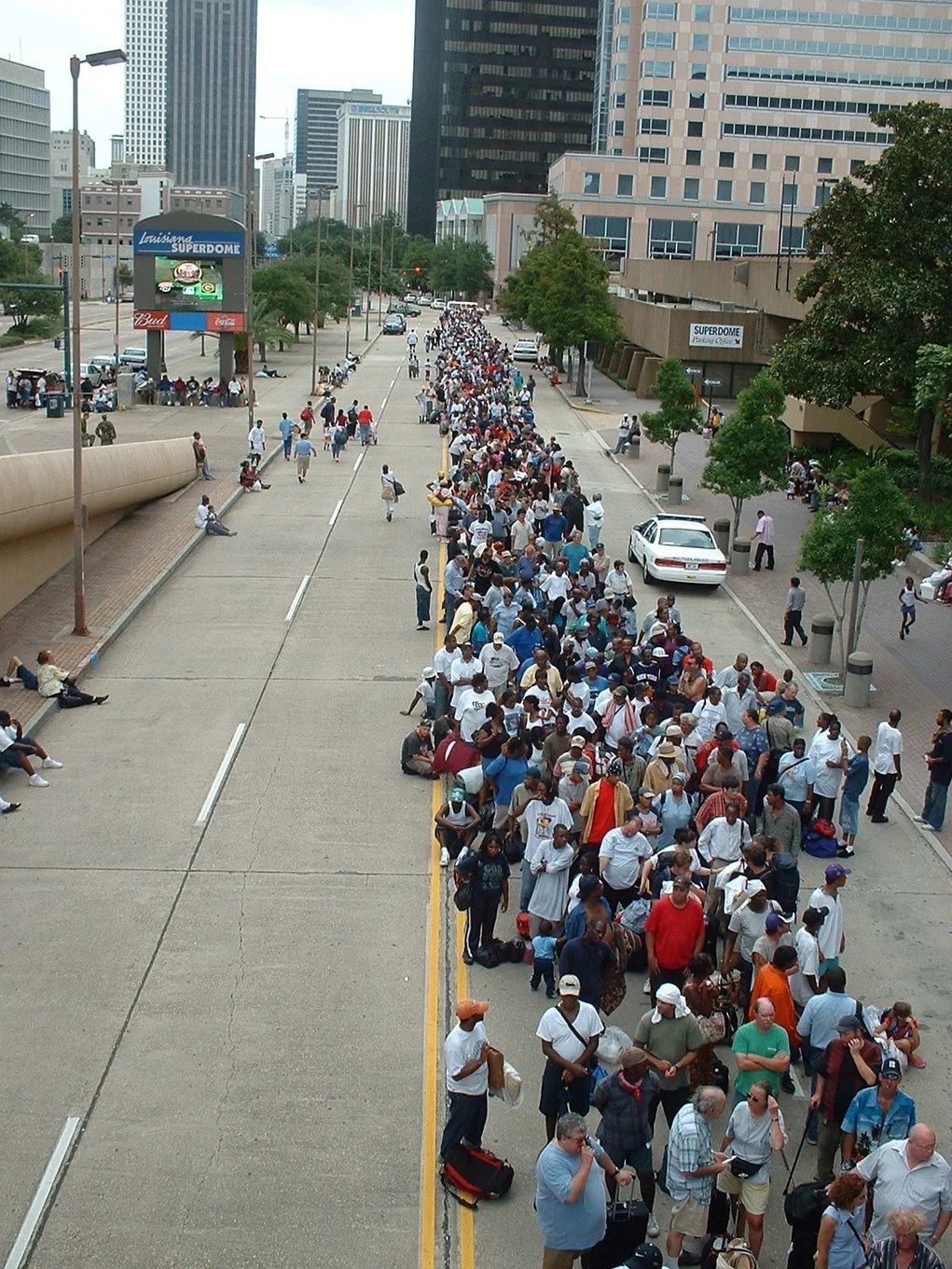
New Orleans residents lining up on August 28, 2005 to get into the Superdome, opened as a hurricane shelter in advance of hurricane Katrina. As more fortunate residents evacuate, those left behind do not have transportation or have special needs.
Marty Bahamonde/FEMA (Federal Emergency Management Administration)
The digital divide (who is not there) and climate change
Monica Sanders’ Undivide Project
Zack Littlejohn
The summer Monica Sanders was 14, she and her cousin earned $1,600 shooting a large invasive rat called “nutria” for $20 bucks a tail. On the weekends, they travelled from New Orleans to Terrebonne and Plaquemines Parish to see friends and family. Armed with their grandfather’s 10-gauge shotgun, they spent their days in the swamps and forests, canoeing and hunting the rodents. Sometimes they would even camp overnight. She used that money to buy her school uniform.
If a teenager wanted to earn a few dollars in a conventional job a work permit was required, though difficult to obtain. To get around this, Sanders and her cousin took advantage of the governor's invasive species control program in which the state paid you for every tail brought into the Department of Gaming and Fisheries. Heading into the swamps, 10-gauge in hand, was “getting around a legal construct that was not serving us,” Sanders told me during an April 13, 2026 Zoom meeting. “Would you rather have 14 year olds bagging groceries or running around with firearms? I think that there's a flaw in the legislation. But we didn't know that then.”
Sanders saw a problem. A system’s myopic gaze was failing those outside its purview. The solution for the intrepid teenager: community. Her grandfather's shotgun, her cousin’s company, and friends and family in the parishes. She reflected on that summer, “I do think that the decision to do mutual aid and other work to support people who have been displaced by disasters, that was another legal infrastructure issue that was failing us.”
The notion of a couple of armed teenagers trekking deep into the swamp to spend all day shooting rodents larger than a football would set outsiders on edge. But for Monica Sanders and her New Orleans community there was nothing more normal.
“Nature, being outside, it was just part of my natural state of being” she recalled. Whether it was drum circles at Congo Square Sunday after church, pop up barbecues on the Fly (a park along the Mississippi), or visiting the parishes to hunt, fish, and runaround with family and friends, life happened outside. It was “a pretty typical New Orleanian upbringing” she said. “Lots of extended family around, close-knit communities. A very deep relationship with nature and the environment. There's a reason why they call the state the sportsman's paradise.”
Along the Gulf of Mexico coast, disasters were also a natural part of Delta life as blues musicians lamented in songs like “When the Levee Breaks” and “High Water Everywhere” about the 1927 Great Mississippi Flood.
Despite this, the natural world felt safe. “It was an inconvenience to evacuate or to harden your infrastructure, but nobody ever perceived it as life altering or, you know, changing the landscape of entire countries” Sanders explained. But this changed in 1998 with Hurricane Mitch. The once-in-a-century devastation was her first ominous recognition of climate change: “there is something different about what’s happening now,” she thought then. “It was the summer after that that I saw how it was changing Louisiana.”
The first change was to her beloved Chandelure Islands, where growing up, she would have picnics and watch dolphins. What were once places for adventure and fun disappeared into memories: “when you look at them today, most of them are underwater.” This motivated Sanders to get involved in environmental advocacy clubs in high school and college.
Despite her passion for outdoor adventure and nascent environmental concerns, teenage Monica Sanders was set on a career in journalism “because most of my family were doctors, lawyers, judges, and business people” she told me with a laugh. Inspired by her idol, New Orleans TV news anchor Sally Ann Roberts, the first seven years of Sanders' professional career were spent telling stories.
Sanders won an Emmy for her coverage of the 9/11 attacks and subsequent wars. While writing one story about the ecological impact that the war had wrought onto central Asia, she began to think differently about people’s relationship with the environment. It was revelatory: “We don't think about that, that there's more than one way to harm a population during armed conflict.” From there, “I started drifting that way. And was thinking about changing to law. And then Katrina happened.”
Two days after the eye passed, the levees broke. In the confusion leading up to the storm, officials failed to properly inform people of the danger, “So we had gone, a lot of people had done so, and then went back and then the levee system breached” she recounted during our call. “There were people already in the Superdome that had evacuated, but that's how you got this race of people on their roofs and running out. Because there was still rain and many tropical storms and depressions and things like that. That's what we got caught in.”
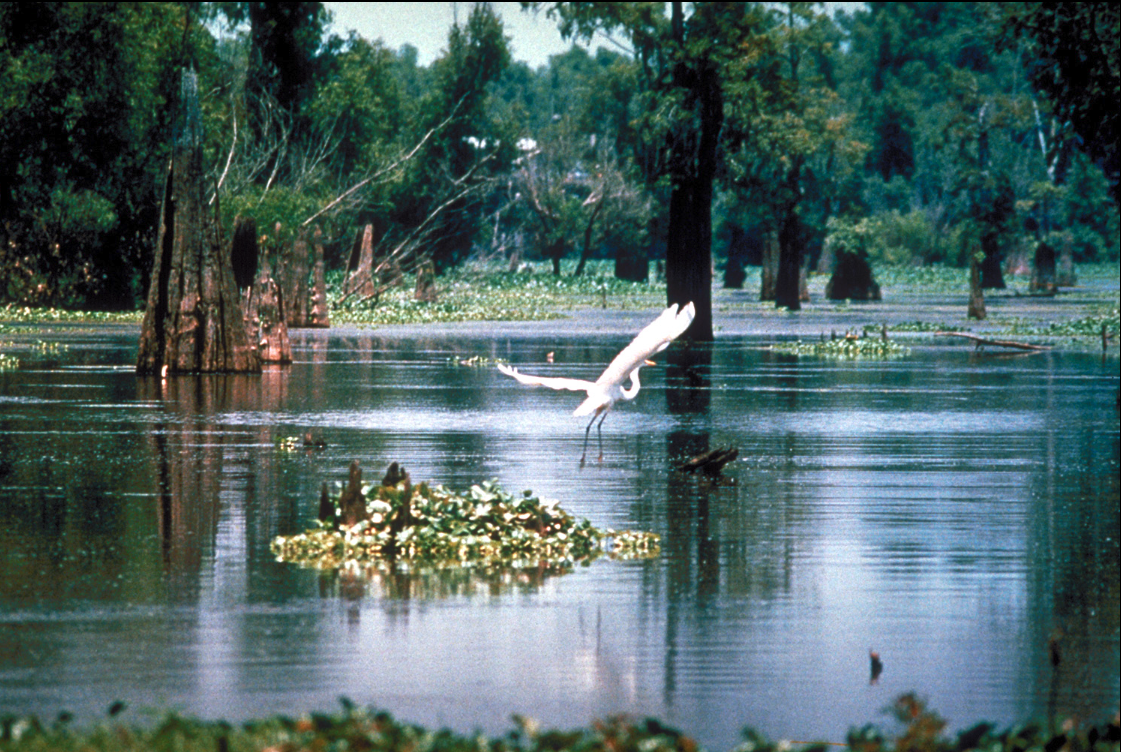
The Terrebonne parish swamp is in the Atchafalaya basin of Louisiana. The army photographer captured a idyllic moment in the richly biodiverse swamp that includes swarms of large (20 lb+) rats.
U.S. Army Corps of Engineers Digital Visual Library
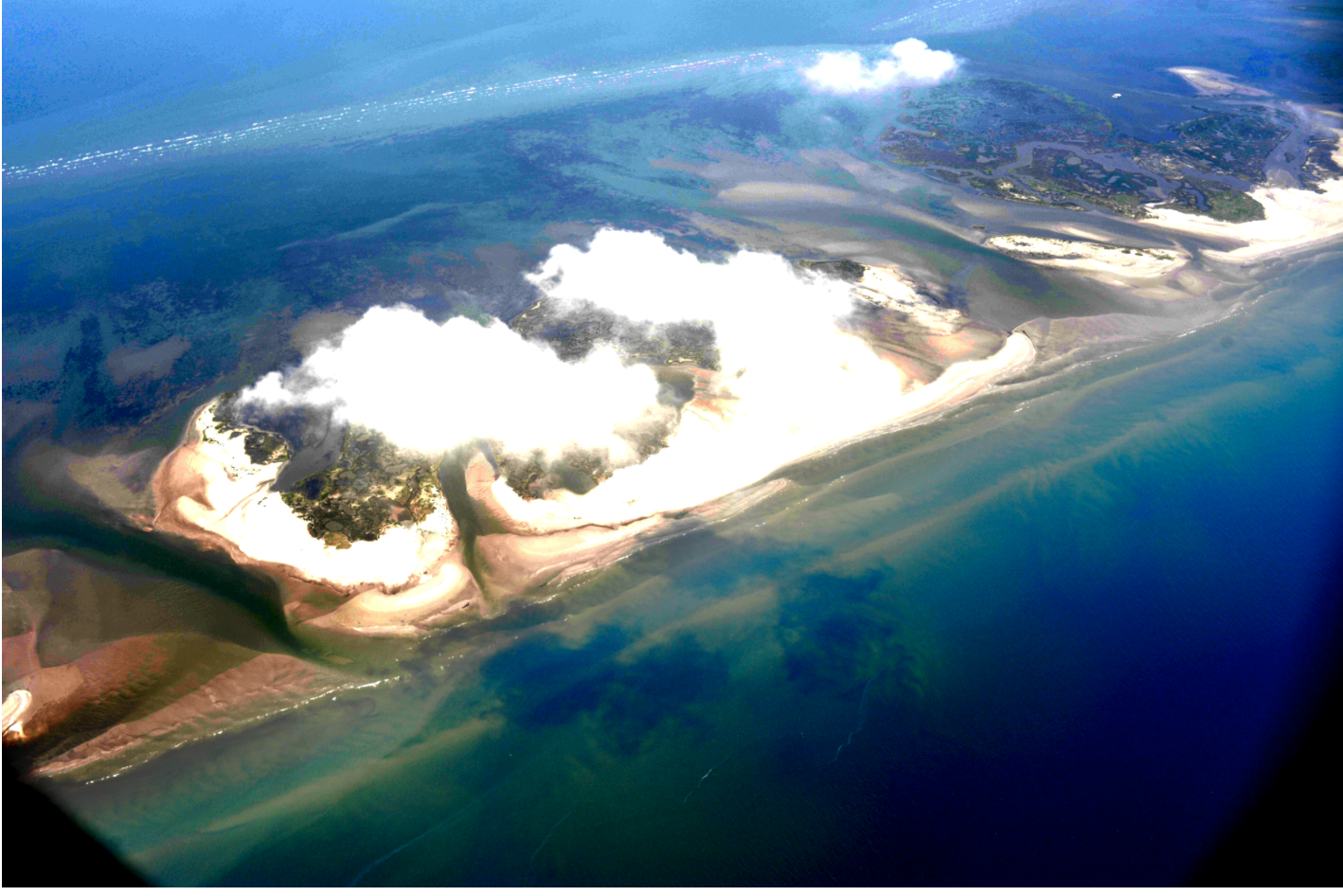
Devastation of Monica Sanders’ beloved Chandelure Islands.The islands had been slowly eroding but were predicted to be land masses for about 300 years. However in 1998, Hurricane George destroyed the islands and left the lighthouse in the middle of the ocean. The barrier islands had only just recovered when Hurricane Katrina struck on August 29, 2005. Hurricane Dennis and Hurricane Katrina both in 2005 reduced the island to shoals (sub-surface formations).
The situation only gets worse. In 2010, the Deepwater Horizon oil spill slicks from the 2010 British Petroleum spill surrounds the shoals in this aerial photo. Credit: Wikimedia commons.
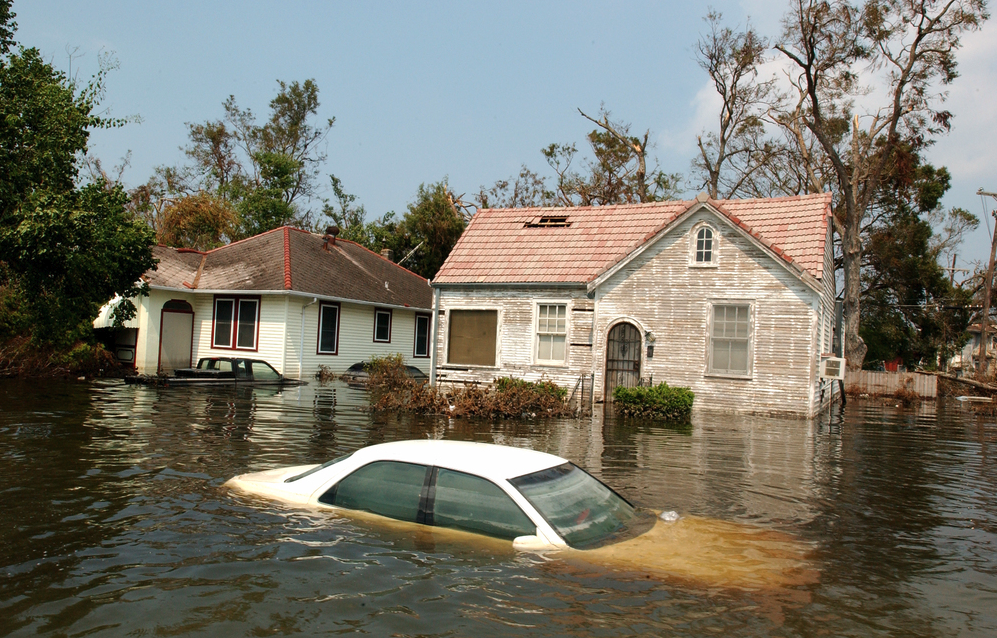
By September 3, 2005, the flood waters had not receded in New Orleans.
FEMA
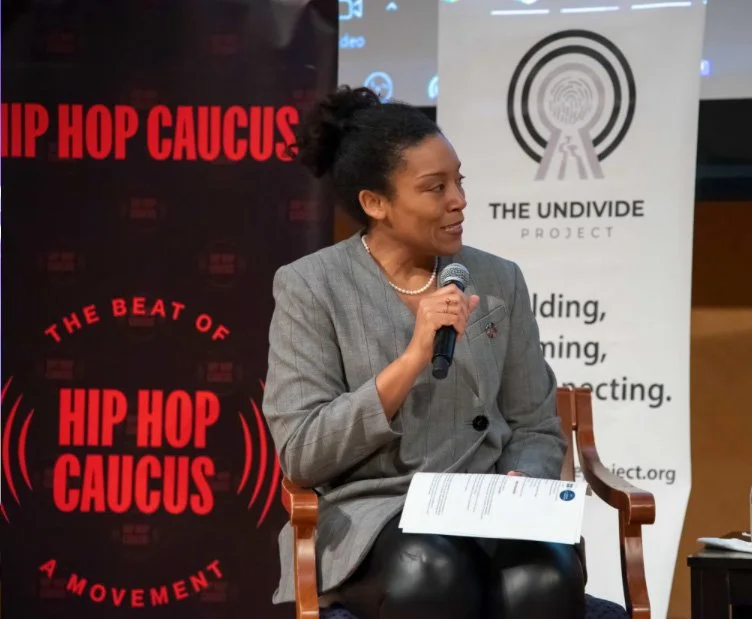
The Undivide Project, in partnership with Earth Commons and the Hip Hop Caucus, hosted a screening of Underwater Projects. The film documents the sinking of Norfolk, Virginia, home to the world’s largest naval base, and the climate justice challenges faced by the city’s historic African American community.
“Over time, it became clear that climate risk, housing patterns, environmental exposure, and broadband access are not separate issues. They are layered systems” — Monica Sanders
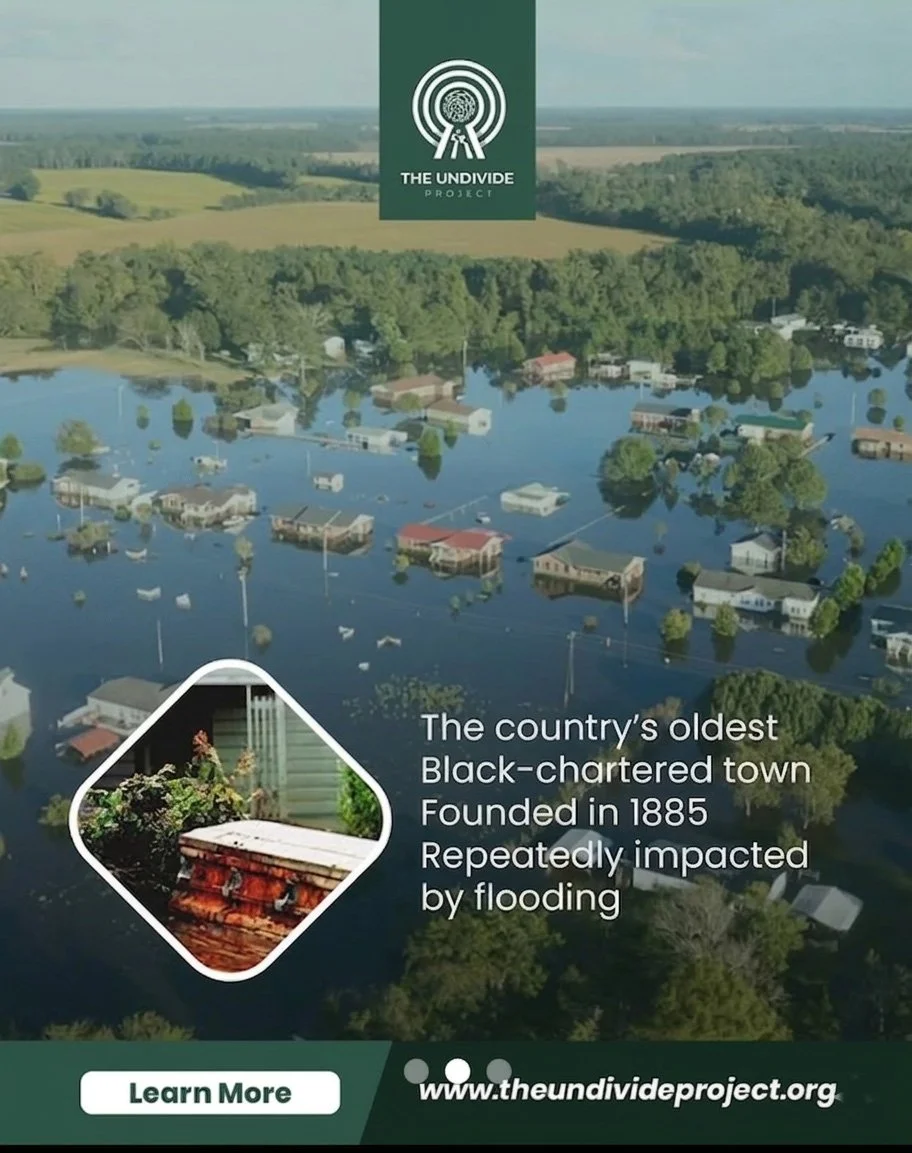
Monica Sanders’ article, "Data Centers Need More Than Permits, Need Public Trust," was published on February 25, 2026 in Broadband Breakfast. The article discusses the environmental and social impacts of the digital economy's physical footprint, particularly regarding energy and water use.
From their miraculously undamaged home in Lakeview, Sanders pulled from the flood waters the “street sign from my cousin's house about three miles away.” At that moment, the city that formed her was gone and its community tattered and dispersed.
When the water finally receded, “It was a shock!” For those stranded, “There was the anger, and then there was the reflex to go outside. Now you all call it mutual aid, but to us, it was just doing what we do best.” With the federal government absent, rescue efforts lagging, and reconstruction only a distant dream, the community said “let's go outside, cook, share, and figure it out.”
A few weeks after Katrina, Sanders left New Orleans for The Catholic University of America, followed by Harvard Law and University College, London. Radicalized and determined, she brought the storm's memory to her studies and after to her career in disaster and environmental law and later academia as a professor and researcher. “Grounding work in lived experience of place helps sustain perspective when addressing large-scale structural issues” she said. “It also reminds me that resilience ultimately concerns the preservation of communities and places that people cherish.”
More than two decades after leaving New Orleans, Sanders has not lost her love of the natural world. When not working, she spends “a lot of time outside walking, hiking, and swimming when the weather breaks here in Virginia.”
Post-Katrina, her relationship with New Orleans is more intentional with HOA’s, noise complaints, private beaches and parks, and “karens” she now has to contend with. But the parishes where she spent her childhood shooting nutria, swimming, and camping are “a little bit more hard to tame than the city.” Whenever she gets the chance, she likes to visit those parks, woods, and swamps that raised her. “I still owe my Brooklyn born husband a proper frog hunt” she laughed.
In the tech bros’ world, if someone has no email, no mobile phone, no social media, no camera, nothing to tie them to the broader world do they even really exist?
The Undivided Project’s climate risk dashboard provides insights into climate-related risks, helping communities and policy makers made informed decisions to build better futures.
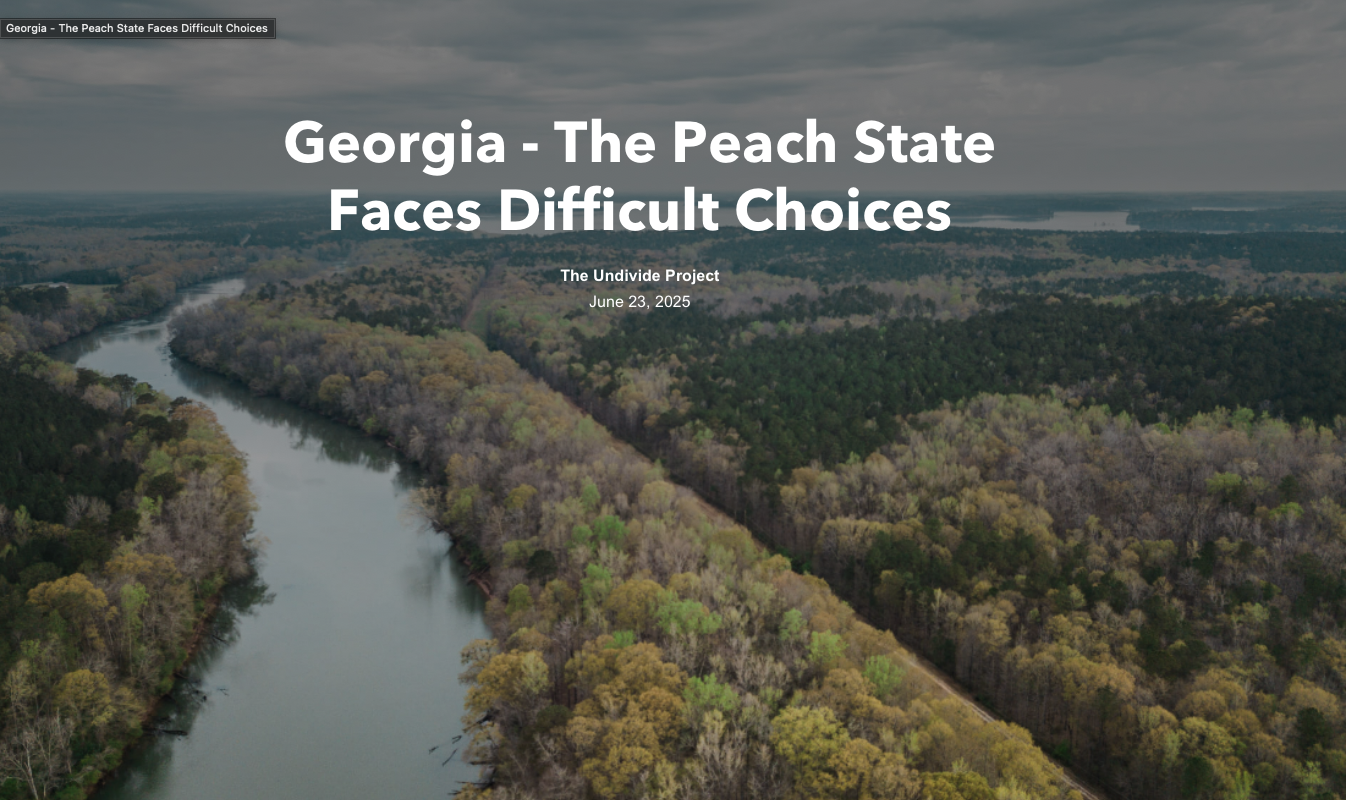
Georgia is one of The Undivide Project’s “Ten States” investigations. Challenges that disproportionately affect Georgia’s Black communities and low-income residents include voting maps, climate impacts on coastal areas, lack of reliable internet in rural regions, and pollution harming health in places like West Savannah and Brunswick.To see how The Undivide multidisciplinary investigation works, view the report here.
The context
Each time we leave the house we do so with smartphones in our pockets, when we clock in to work we turn on our computers, to reach out to a friend we text, and to speak with a colleague we send an email. We socialize, work, learn, and even love through the prism of technology.
It’s overwhelming for many with screens filling every empty moment in life. We have become so accustomed to technology’s ubiquity that we often wish for a moment of analog respite. From within its digital grasp, we rarely think of those for whom technology is a rare and precious tool. We forget about the communities for whom the internet is fleeting and weak, where accessing a computer is a time consuming task, and where social media’s always observant eyes do not look. In a world where seemingly everyone has technology, those who have fallen through the cracks often are forgotten as we do not think about what we do not see.
In the tech bros’ world, if someone has no email, no phone, no social media, no camera, nothing to tie them to the broader world do they even really exist?
That is the problem Monica Sanders has set out to solve with The Undivide Project. The non-profit addresses the intersection of the digital divide and marginalization in the face of climate change’s exacerbation of inequality. Their mission is not simply to bring technology to people but to bring people together through technology. In doing so, they can empower communities suffering the brunt of ecological disaster and decline in ways that go beyond disaster prep and relief.
The Undivide Project, Sanders told me via email, “involves creating platforms that help communities visualize risk, track public investments, and participate meaningfully in planning decisions.” She added, “we work on mapping climate exposure alongside digital access, health indicators...and economic conditions.”
These initiatives seek to empower the disconnected and discarded communities as they struggle disproportionately from climate change. For these communities, when “residents and local leaders can see these correlations in clear formats, they are better positioned to advocate for targeted investments. Technology becomes a tool for transparency, accountability, and informed civic engagement rather than an end in itself.”
Monica Sanders brings to The Undivide an exceptionally strong and broad skillset as a journalist, researcher, entrepreneur, academic, and lawyer who examines racial inequality, disaster law, climate change, and the digital divide.
Sanders' background is reflected in The Undivide Project’s focus and mission. The project sits at the intersection of race, climate, and technology, exploring how these forces create and perpetuate inequality in our highly technological and unequal society.
The seeds of this work “began with disasters” in Sanders’ New Orleans home town. She says that following Hurricane Katrina’s devastation, she “saw how legal frameworks shape who receives aid, who is left out, and how rebuilding decisions are made. Over time, it became clear that climate risk, housing patterns, environmental exposure, and broadband access are not separate issues. They are layered systems.”
Informed by this, The Undivide Project identifies who is left out from relief and provides them not rescue but the tools of climate resilience by means of community resilience. Sanders goes on to explain that the layered systems require lateral resolution: “Community development determines whether neighborhoods have the assets to recover...digital infrastructure determines whether people can access alerts, apply for relief, work remotely, or maintain social ties during displacement. The connective tissue among these fields is equity in access to systems that sustain life and livelihoods.”
Falling through the cracks of climate change and the digital divide
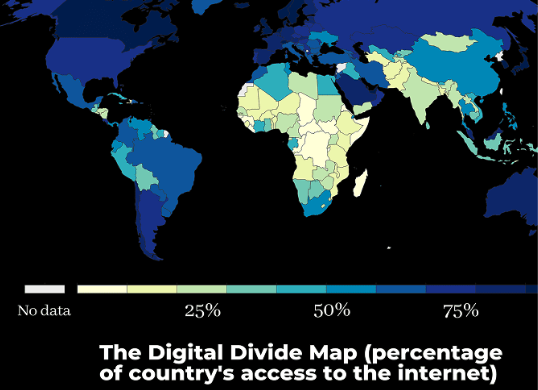
At the beginning of the Covid-19 pandemic, the United States shut down and went online as society became digital. Five years after the pandemic, access to reliable broadband and other modern technologies is a prerequisite to survival. For those at the bottom of the socio-economic hierarchy, access to the internet is vital for managing money and banking, paying bills, applying to jobs, gig work, healthcare tasks and appointments, education, communication, and more.
As a consequence, the more than one third of Americans who lack or have limited access to the internet are isolated and cut off from the world economically, socially, and politically.
These inequalities are compounded by the new normal of climate change. It is a normal in which disaster and ecological decline wreak havoc on the most vulnerable at an alarming rate. Where what were previously once in a generation disasters are now seasonal.
Tracking the annual rate of distastors, the Institute of Economics and Peace recorded 39 natural disasters in 1960, by 2019 that number had risen to 396. These conditions pose an existential threat to the aging and ailing infrastructure of the United States, which already struggles from scattered areas of disinvestment and political malaise. This decaying infrastructure is further undermined by the Trump administration’s chaotic domestic policies and repercussions of certain international policies. Together, these exacerbate deeply entrenched racial and economic inequalities.
Monica Sanders has been speaking out about these inequalities vis-a-vis climate change. In an Oct. 25, 2022 Forbes interview, Sanders noted that for struggling BIPOC communities, when disaster strikes, they “face hindrances like prolonged wait times for the restoration of utility services such as electricity and water, personal loss, property damage, and lack of essential resources, including food, shelter, and income.”
As a stark example, consider Alabama’s Black Belt region. In a May 19, 2025 op-ed in The Regulatory Review, Sanders explained that “more than 30,000 homes have failing septic systems that are worsening due to increased rainfall.” She noted that “A now-terminated U.S. Department of Justice investigation found that the state’s failure to address wastewater infrastructure in Lowndes County constituted a civil rights violation.”
She continued, “residents in this region are also among the least digitally connected in the nation—many do not have reliable access to email or internet-enabled devices. When disaster strikes, they are cut off twice––first by infrastructure, and then again by information.”
According to Sanders, when disaster strikes, “internet access is not a luxury. It is the mechanism through which evacuation orders are delivered, relief applications are filed, insurance claims are initiated, and families locate one another.”
In the era of climate change, disaster is inevitable and damage compounds. Like a thousand cuts, collapsed bridges, tattered roads, damaged utilities, loss of jobs, property damage, and interruption of social bonds fracture social and economic networks that are the precious and precarious lifeline for struggling communities.
When the physical world becomes an obstacle to life, digital platforms “provide continuity” Sanders wrote during our email exchange. “Schools move online. Telehealth replaces in-person visits. Gig workers and remote employees can continue earning income if connectivity is intact. Community groups use social media and messaging platforms to coordinate mutual aid.” The digital divide does not simply disconnect people from the internet, being disconnected from the internet disconnects them from the rest of the world.
The digital infrastructure functions as a form of social infrastructure and this function becomes particularly critical during crises. “It helps preserve human networks when physical infrastructure is compromised” Sanders said. “When communities lack access to the internet and digital platforms, they face delays or life-threatening challenges because they also lack access to these social and financial lifelines.”
The Undivide Project: Building local networks through technology
The convergence of the digital divide and climate change represent structural malice. Rural, BIPOC, and low-income communities are not simply underserved but “are systematically excluded from the tools, information, and legal protections necessary to survive a climate emergency,” explained Sanders in the 2022 Forbes interview. For those on the edges of the modern world, “the failure to treat broadband access as an essential utility and emergency service is worsening the climate resilience gap in America.”
The Trump administration has accelerated this as it slashes funding, sabotages environmental and relief programs, and reverses regulations that combat climate change. The federal government is relinquishing its duties of providing resources, support, infrastructure, and safety nets to Americans while turning the full power of the state against the most vulnerable.
Confronting these problems requires developing new strategies for empowerment and resilience. This propels The Undivide Project’s theory of change, which maintains that resilience against climate change cannot come from the top down. This is because, too often it is those at the top that have sentenced vulnerable communities to the margins.
The solution is not to wait for rescue but to organize with neighbors. In our Q&A, Sanders explained that at The Undivide this process begins with listening. “When working with communities that have experienced disinvestment or broken promises, the first principle is listening.” She revealed that “Data collection and mapping efforts are preceded by conversations with local partners. We ask what information is useful to them, how they define resilience, and how findings should be shared.”
Accomplishing The Undivide’s goals means investing in social capital, which Sanders says “exists in trust networks, civic participation, and informal communication systems.” It is through technology that social capital and thus resilience are built.
However, investing in social capital required a new framework for measuring resilience. Traditional models of investment measure success through hard infrastructure such as bridges, roads, dams, and the profits they hopefully generate. This can be a good way of measuring economic growth but is blind to social growth and the wellbeing of people.
Reorienting their strategy meant “developing better metrics that capture avoided losses, reduced recovery time, and improved labor force participation linked to connectivity and trust-building initiatives,” Sanders said during our exchange. A community is only as strong as the relationships between those within it.
Consequently, “neighborhood-level connectivity initiatives can support workforce development, small business continuity, youth education, and local entrepreneurship.” For communities that must manage without, the benefits of this social investment “may look like a neighborhood hub that doubles as a resilience center and a co-working space. It may mean older residents gaining access to telemedicine. It may mean local entrepreneurs reaching regional markets online.”
After the disaster, when the flood waters recede and the storm dissipates, disruption settles into what survived. It is the economic disruption of not knowing when your next paycheck will come or if you still have a job. It is losing access to friends and family as well rituals and events that no longer take place. It children unable to attend school, and medications you cannot refill. Disruption denies continuity, security and community and even having no place to call home.
In creating The Undivided Project, Monica Sanders saw that in the most catastrophic moments, outside rescue will not always come. For communities sinking in the flooded cracks of the digital divide, rescue comes from neighbors working together to lift each other up. And she emphasized the compounding benefits of this cooperation:
When the flood waters retreat and leave in its wake destruction, the “same systems that help people survive disasters also strengthen economic participation and civic trust during normal times.”
Zack Littlejohn is a NYC-based organizer and cultural anthropology graduate student. He writes about political culture, community, and environmental justice.